Not Fit for Leadership

Image: cat with big green eyes staring straight, using a walker, front paws on the walker arms.
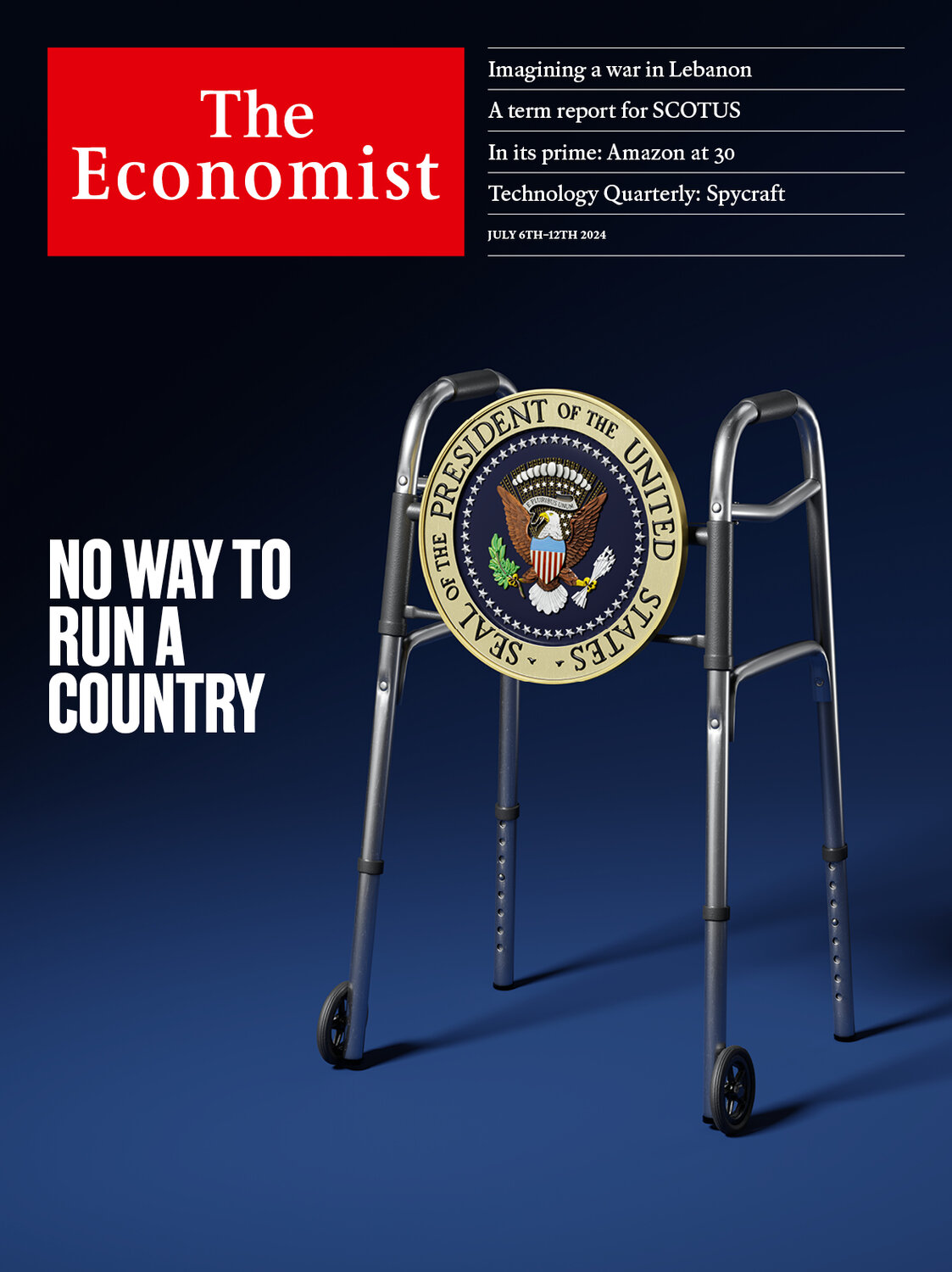
Economist cover showing a walker with the presidential seal. Words No Way to Run a Country

Guest blogger Carrie returns this week with a timely blog post about the upcoming presidential election, abelism, and disability justice.

The July 4th cover of The Economist was a picture of a walker with the Presidential seal, accompanied by “No Way to Run a Country.” The article about why Biden must withdraw included a subheading: “The president and his party portray themselves as the saviours of democracy. Their actions say otherwise.”

Regardless if you feel as if the presidency is an underwhelming lifetime achievement award or pivotal to seeing the next generation exist, you have to take note that this move by The Economist is well-played and ableist. A walker symbolizes not only aging and decline, which will happen to all of us, but also feeblemindedness, vulnerability, incompetence, and dependence. On the cover, the walker is empty– there’s no picture of Biden, nothing happening, just a mobility device taking up space, while no work is performed.

As a disabled person, I cringed at the cover, but I was not surprised. The quickest way to undermine someone is to question their competence and professionalism. The Economist’s line about saviourism is apt, too. It reads to me as: Disabled people are so frail, such a suck on society, that they cannot even save themselves. They expect nondisabled people to take care of them and give them leadership positions? Who are they fooling?

Most disability organizations are not even led by disabled people because a charitable view of disability pervades society. Disabled people can be inspiring, can remind us of how grateful we are to not be like them, can be funny and self-effacing, and overachievers, but they cannot be full or flawed humans. They must understand their place, show gratitude, and understand their access to power can be easily taken away. Every leadership position I’ve occupied has felt like this dance between advancing disabled folks as leaders and not offending nondisabled folks who were kind enough to hire me or allow me to remain in place. I realize that perspective reflects an unhealthy dose of internalized ableism, but to go through the world as a leader with disabilities, especially one with mobility equipment, is to feel precarious. It isn’t the equipment that makes me precarious– it’s the nondisabled people.

Don’t get me wrong: I believe much of how nondisabled folks react to disabled people is not intentional, and sometimes, not even within their awareness. The reality is that becoming disabled is one of people’s greatest fears, along with aging and death. If people are grappling internally with their terror about becoming like me or having to stand behind a walker, then they can’t see me or others in my community as full people. 

Others in disability communities have altered The Economist image with a reminder that President Franklin D. Roosevelt had disabilities. My first reaction to this reclaiming of disability was President Roosevelt seemed to feel tremendous pressure to conceal his disabilities and mobility equipment. Early narratives that touched on his disability were focused on him “overcoming paralysis and polio”, which only further makes disability something to avoid, get rid of, or make palatable to others. The reality was FDR realized that too much sharing of his disability made him unelectable. I understand the community’s need to claim FDR as one of our own, but I also imagine he would not be leading the celebrations of July as Disability Pride Month. Similarly, I have no idea what President Biden’s sense of disability identity is, apart from his acknowledgment of his experiences with stuttering.

I’m not sad or enraged for Biden, but I am for anyone who sees that cover and thinks, “Well, that’s confirmation of something that I’ve always felt– no one sees me as fit to lead.” How long will it be before we have mainstream magazine covers where our most powerful leaders across sectors and at all levels of elected office are sporting their mobility equipment as a sign of strength, pride, and function? 

Carrie Basas (she/they) is a consultant with CoDesignWorks: carrie@codesignworks.com. While not working she can be found singing and talking loudly in her garden and doting on her two cats. Carrie has a MEd in Education Policy, Organizations and Leadership from the University of Washington. She earned a Juris Doctorate from Harvard Law School and an Honors B.A. in Psychology with a minor in Sociology/Anthropology from Swarthmore College.


Thank you to our Patreon subscribers. At this time I don’t offer ‘extras’ or bonuses for Patreons. I blog after working a full-time job, volunteer and family commitments thus it is hard to find time to create more content. Whatever level you are comfortable giving pays for back-end costs, research costs, supporting other POC efforts, etc. If your financial situation changes please make this one of the first things you turn-off — you can still access the same content and when/if you can re-subscribe I’ll appreciate it.

Adrienne, Aimie, Alayna, Alessandra, Alexa, Aline, Alison FP, Alison P, Allison, Amanda, Amber, Amira, Amy, Amy K, Amy P, Amy R, Andie, Andrea J, Andrea JB, Andy, Angelica, Ashlie, Ashlie B., Barb, Barbara, Barrett, Beth, Betsy, Big Duck, Brad, Brenda, Bridget, Brooke B, Brooke DW, Cadence, Caitlin, Calandra, Callista, Cari, Carmen, Carolyn, Carrie B, Carrie C, Carrie S, Catherine, Cathy & David, Chelsea, Christina C, Clara, Clark, Clark G., Courtney, Dan, dana, Danielle, Danya, Debbie, Debbie S., Dede, DeEtta, Denyse, Dennis, Dennis F, Diane, Don, Ed, Edith, Eileen, Elizabeth, Emily, Erica J, Erin, Frances, Gene, Genita, Hannah, Hayden, Heidi and Laura, Heidi, Hilary, J Elizabeth, Jaime, Jake, James, Jane, Janet, Jelena, Jen C, Jen E, Jen H, Jena, Jenn, Jennet, Jennifer, Jess, Jessica F, Jessica G, Jillian, John, Jon, Julia, Juliet, June, Karen, Kate, Kathryn, Katie O, Kawai, Kelly, Kiki, Kimberly, Kyla, LA Progressive, Laura, Lauren, Leslie, Linda M, Lisa C, Lisa P-W, Lisa S, Liz, Lola, Lori, Lyn, Maegan, Maggie, Maile, Maki, Marc, Mareeha, Marilee, Matthew, Maura, Melissa, Melody, Michael, Mickey, Migee, Mike, Mindy, Misha, Molly, Nat, Nicole, paola, Peggy, PMM, Porsche, Rachel, Raquel, Rebecca, Robin, Ryan, Sally, Sally P., Sandra, Sarah B, Sarah D, Sarah H, Sarah KB, Sarah R, Sarah S, Sarita, Selma, Sharon B, Sharon Y, Shaun, Shawna, Siobhan, Steph, Stephanie, Stephanie J-T, Steve, Su, Sue, Sue C D, T Wang, Tamara, Tania DSA, Tania TD, Tara, tash, Teddi, Tim, Tracy TG, Venu, virginia, Vivian, Wan-Lin, Ward, Wendy, and Zan

Thank you for subscribing. Please check fakequity.com for the most up-to-date version of the post. I often make grammatical and stylistic corrections after the first publishing which shows up in your inbox. To subscribe — on the right sidebar (desktop version) is a subscribe box. To see what I’m reading and recommended books check out the Fakequity Bookshop. I am an affiliate of Bookshop.org where your purchases support local bookstores. I earn a small commission if you click through and make a purchase. The commission goes into purchasing books by POC authors or about disabilities to donate to high-poverty public schools.

Do You Take Crip-Dough? — Redesign your fundraisers

First to my Seattle friends and neighbors, please be extra kind to the educators and kids. The news that another student has died because of gun violence at school is hitting hard, especially during a time of the school year that is often marked with celebrations and graduation. If you can take care of another person, please extend that to the POCs, students of color, and allies. I re-read the blog post I wrote in 2022 after another school shooting in Seattle. We need to do better.

I welcome back my favorite guest blogger Carrie to tell us why many mainstream fundraisers are not disabled friendly or inclusive.


Plate of food — green beans on the left, chicken on the right, on a white plate, fok and knife beside the plate on a cloth napkin. Photo by Jer Chung on Pexels.com

Recently, I was invited by friends to several, let’s say, mainstream, fundraising events– one for a large nonprofit and another for a campaign. (Before you decide this is my thing and you want to invite me to yours, please read on and know that I feel fully satisfied with mainstream events for 2024.) Then I had the honor of being the crone auntie for graduating Harvard students with disabilities by telling them about all the unpaid labor they could expect to do. Apparently, I left out one of those tasks– cripping fundraisers.

Now, when my friend invited me to be part of her diversity efforts for the large nonprofit, I felt like:

  • These folks don’t need my money.
  • I love her, so I will do it, and she will endure whatever postmortem comes her way— especially if my very arrival at the event involved an elevator that has been broken for weeks and a path of travel missing curb cuts.

Attending the event reminded me that fundraising professionals of all kinds are fully missing out on exploiting me for my crip-dough (i.e., disabled lady dollars). While disabled folks are at least 20% of the population, they are absent from most of these rooms. At the large nonprofit, I found some of my people when I took over a tiny table in the corner when others were expected to meander and learn before the plated chicken unveiling. I should have charged for those seats and donated the money to a smaller institution. My people and their family members will find the quiet nooks. 

Similarly, at the campaign event, I was heartened to find friends trying to eat snacks in a corner or hoping to have conversations where they weren’t just nodding along and not hearing anything. I was also grateful to my host for providing the parking options, finding me when I arrived, and saving me a spot to rest.

For the nonprofit event that hosted 400 or more people, access features were decidedly absent. The room arrangement was poor, so there was no clear line of sight to the speakers. A few monitors were placed in awkward positions around the room, but they weren’t working consistently and there was no captioning. (For a donor base of older folks, who might not identify politically as having disabilities, but need to hear or read your heartwarming appeals for $500,000, this is a misstep.) There was no ASL interpreter. I was the only person with a visible disability– which is a surveying past-time I enjoy when I can’t always hear or see the speaker and have no idea where to direct my body. My other pro bono service was processing with several other attendees– some strangers– how they didn’t realize that one of the gender-inclusive bathrooms was a wall of urinals. Let’s be trauma-informed with our signage. I redirected them to search for the other door that had disability and stall signs, though not all stalls were accessible.

For a lot of focus on bringing services to communities, there was no mention (or I couldn’t hear it) of disability and youth. If you want me to give and bring along my people, I have to exist in your appeal. At the campaign fundraiser a few days later, I was sucked in by calls for representation, but I was still wondering what that meant about commitment to issues in my community. I tried not to deduct frustration points for having to remove sandwich boards near the only elevator to get to my seat. Something about that event made me feel like I should run for office, which I realized was a sign of too much Kool-Aid for me, so I sought fresh air after those feelings. However, seeking that fresh air meant I had the choice of either charging the stage to reach the elevator when 500 people were walking towards me to take the stairs. 

Here are some next steps for fundraising professionals, executive directors, campaign managers, and Board members:

  • If you’re a large organization, build in basic accessibility and relevant information about access needs to your event. Don’t wait for someone to ask for inclusive planning – see my previous post about having to be a disability doula, don’t put that burden on disabled people, orgs this is your burden. Communicate what you’re already providing and know that I will spam my people to highlight what you’re signaling to us. Build it and they will come– unless you’re committed to keeping your broken elevator and also asking us for money.
  • If you are in a leadership role where you feel as if you are pushing a group for diversity and inclusion, yet you do not identify as having a disability, use your position to advocate that the organization do better and learn together.
  • Provide as many details about the event so that people can identify their access needs. What is the schedule? What spaces and transitions are part of the event? What’s the format? Where are the closest entrances? Public transit options? Access request contact and turnaround?
  • Include us in your work genuinely throughout the year so that we are appearing in your heartfelt pleas, promotional images, and leadership. 
  • Pay disabled consultants to assist you with event planning and debriefs.
  • Know that accessibility and belonging efforts are always evolving and that you shouldn’t treat missteps as an excuse for avoiding access entirely. The problem isn’t disabled people, buildings, or stages with stairs– it’s that we aren’t having open and proactive conversations that lead to welcoming, affirming experiences for people we note casually in our standard DEI language. You will mess up, but the biggest mistake is the failure to try and then the avoidance of any feedback.
  • Attend events run by disability-led organizations to understand what those spaces look and feel like. While you’re there, donate some money. Most of our organizations can’t get $500,000 over a lunch; they are excited to raise $20,000 at an event and yet they commit to accessibility as a baseline.
  • Forge authentic relationships with disability organizations that evolve into shared resource-generation spaces and strategies.

I’m waiting to be wooed. Meanwhile, I’ll try to get better at capitalism so I have more to donate to you once you find your way into my heart.


Carrie Basas (she/they) realized after several chicken lunches and dinners of cheese and cookies that her heart is in assisting organizations with building their capacity for disability as belonging. She is now consulting through CoDesignWorks. carrie@codesignworks.com


Thank you to our Patreon subscribers. At this time I don’t offer ‘extras’ or bonuses for Patreons. I blog after working a full-time job, volunteer and family commitments thus it is hard to find time to create more content. Whatever level you are comfortable giving pays for back-end costs, research costs, supporting other POC efforts, etc. If your financial situation changes please make this one of the first things you turn-off — you can still access the same content and when/if you can re-subscribe I’ll appreciate it.

Adrienne, Aimie, Alayna, Alessandra, Alexa, Aline, Alison FP, Alison P, Allison, Amanda, Amber, Amira, Amy, Amy K, Amy P, Amy R, Andie, Andrea J, Andrea JB, Andy, Angelica, Ashlie, Ashlie B., Barb, Barbara, Barrett, Beth, Betsy, Big Duck, Brad, Brenda, Bridget, Brooke B, Brooke DW, Cadence, Caitlin, Calandra, Callista, Cari, Carmen, Carolyn, Carrie B, Carrie C, Carrie S, Catherine, Cathy & David, Chelsea, Christina C, Clara, Clark, Clark G., Courtney, Dan, dana, Danielle, Danya, Debbie, Debbie S., Dede, DeEtta, Denyse, Dennis, Dennis F, Diane, Don, Ed, Edith, Eileen, Elizabeth, Emily, Erica J, Erin, Frances, Gene, Genita, Hannah, Hayden, Heidi and Laura, Heidi, Hilary, J Elizabeth, Jaime, Jake, James, Jane, Janet, Jelena, Jen C, Jen E, Jen H, Jena, Jenn, Jennet, Jennifer, Jess, Jessica F, Jessica G, Jillian, John, Jon, Julia, Juliet, June, Karen, Kate, Kathryn, Katie O, Kawai, Kelly, Kiki, Kimberly, Kyla, LA Progressive, Laura, Lauren, Leslie, Linda M, Lisa C, Lisa P-W, Lisa S, Liz, Lola, Lori, Lyn, Maegan, Maggie, Maile, Maki, Marc, Mareeha, Marilee, Matthew, Maura, Melissa, Melody, Michael, Mickey, Migee, Mike, Mindy, Misha, Molly, Nat, Nicole, paola, Peggy, PMM, Porsche, Rachel, Raquel, Rebecca, Robin, Ryan, Sally, Sally P., Sandra, Sarah B, Sarah D, Sarah H, Sarah KB, Sarah R, Sarah S, Sarita, Selma, Sharon B, Sharon Y, Shaun, Shawna, Siobhan, Steph, Stephanie, Stephanie J-T, Steve, Su, Sue, Sue C D, T Wang, Tania DSA, Tania TD, Tara, tash, Teddi, Tim, Tracy TG, Venu, virginia, Vivian, Wan-Lin, Ward, Wendy, and Zan

Thank you for subscribing. Please check fakequity.com for the most up-to-date version of the post. I often make grammatical and stylistic corrections after the first publishing which shows up in your inbox. To subscribe — on the right sidebar (desktop version) is a subscribe box. To see what I’m reading and recommended books check out the Fakequity Bookshop. I am an affiliate of Bookshop.org where your purchases support local bookstores. I earn a small commission if you click through and make a purchase. The commission goes into purchasing books by POC authors or about disabilities to donate to high-poverty public schools.