25 Things I Know About White People

20190530_234715

Editor’s Note: Happy (early) Eid to our Muslim relations. Eid is on Tuesday. 

This blog post started from a stalled attempt to write about bravery, the words weren’t jelling. The points below are generalizations. I know and you know not all white people fall into each of these 25 categories. I share this to point out how whiteness shows up in different places and in different ways. I also share it so maybe those who are ready can ask themselves if these points apply to them and what are they doing to uphold or undo white-harm. Some of the points below also apply to BIPOCs, especially those with different forms of privilege and we also need to be aware of our roles and actions.

25 Things I Know About White People:

  1. White people like to be praised for being brave. But really the bravery they feel is just everyday actions of BIPOCs – like sending their kid to a diverse school, talking about racism, talking about how to behave around law enforcement.
  2. White people have a hard time being called white. “But I’m an individual,” see me as me – yet it is ok to group BIPOCs together and to hold stereotypes about them.
  3. White people can be fragile. Anything to do with race or pointing out how white superiority works and you can clock how fast they change the conversation.
  4. White people can be lazy and not want to think about race, “Can’t we all get along?”
  5. Along with the laziness they want to be spoon-fed information about race versus having to sit with the uncomfortable parts and process their role in upholding racism.
  6. White people have been raised to have a picture in their head about what it means to be white.
  7. White people like to learn about race from other white people – code Robin DiAngelo. I appreciate DiAngelo’s work, but only learning about race from white people is just a different form of whiteness showing up.
  8. White people don’t like to admit they have white privilege or often act in white superiority ways.
  9. White people are gatekeepers for the patriarchy and power.
  10. White money often stays in white communities. Ahhem, foundations who give to mostly white led orgs or conservative causes.
  11. White people are quick to point out when they have been slighted “reverse racism,” turning Black Lives Matter into All Lives Matter, or crying how causes aren’t practicing “intersectionality.” Intersectionality has nothing to do with you, do some homework.
  12. White people expect praise and gratitude for welcoming BIPOCs to their table, or reverse they feel slighted and demand to attend BIPOC and “equity” events for woke points.
  13. They demand or seek recognition for charitable gifts when it is really restitution and redistribution of wealth.
  14. White people heap praise and adoration when “minorities” accomplish anything, hello Lifetime and Hallmark Channel movies. Also, white people like to see themselves on TV and in movies, that can be the only explanation for why we don’t see diversity in the entertainment field. This includes disabilities, white people like to see able-bodied white people in their entertainment.
  15. White people get nervous and angry when BIPOCs do anything to disrupt their norms, including kneeling down to protest.
  16. White people like power and privilege and hoarding it.
  17. White people believe in the American dream as defined by white people. White people like to deny the dream to some (e.g. Build the Wall, Islamophobia, Japanese internment-concentration camps, Chinese exclusion act, etc.) or get praised for saving the “poor minorities.”
  18. White people like to control processes. They also like to hear themselves talk.
  19. White people wrote the history books and continue to write our narratives. Writing the history books and current day news and narratives allows white people to control and shape the narratives we collectively hold.
  20. White people like race. Let me unpack this one, they like it as a tool of holding down others and upholding their privilege. Race was created as a tool to separate and sort people, it was developed and continues to be used to control BIPOCs. “But race is the child of racism, not the father.” Ta-Nehisi Coates, Between the World and Me.
  21. White people don’t own their part in creating messes, nor do they stick around to clean things up.
  22. They will show up for marches and rallies, but when asked how many BIPOCs they know the numbers are often very low. Or sometimes I hear the lines “My best friend is Black,” “I’m married to an Asian,” or “I live in a diverse neighborhood,” as ways of saying “I’m not like other white people.” Just don’t, I’m glad you are married, best friends, and live in diverse neighborhoods — but that doesn’t excuse how whiteness shows up.
  23. White people don’t hold other white people accountable for their grievances around race.
  24. White people like to own and take over stuff. Chipotle and Panda Express do not count as ethnic food.
  25. White people believe in the Great White Hope.

A special thank you to my co-writer, Angry Asian Chick-Trout.


Thank you to our Patreon subscribers who help to keep the blog going: Adrienne, Aimie, Ali, Aline, Alissa, Amy, Amy R., Andrea, Angie, Annie, Annie G., Ashlie, Ben, Brooke, Brian, C+C, Calandra, Carolyn C., Carolyn M., Carrie, Carrie S., Casey, Chandra, Chelsea, Chicxs Happy Brownies, Claudia, Cierra, Clark, Colleen, Crystal, Dean, Denise, Denyse, Donald, Edith, Elena, emily, Erica (2), Erica R.B., Erin, Evan, eve, Freedom, Greg, Hannah, Heather, Heidi, Heidi and Laura, Heidi S., Jake, Janis, Jean, Jennet, Jennifer M., Jennifer T., Jessica, Jillian, Jody, John, Julia, Julie Anne, K.T., Kari, Karen, Katheryn, Kathi, Katie, Keisha, Kelli, Kristen, Kristen C., Kumar, Laurel, Laurie, Lisa, Lisa C., Liz, Lori, Lynn, Makeba, Marc, Maura, McKenzie, Megan, Melissa, Michael, Michelle, Mikaela, Mike, Milo, Minesh, Miranda, Miriam, Misha, Molly, Nathan, Nicole, Norah, Norrie, Paola, Patrick, Priya, Rebecca, Rise Up for Students, Robin, Ruby, Sarah, Sarah S., Sean, Selina, Shannon, Shaun, Shawna, Shelby, Stephanie, Stephanie S., Tana, Tara, Terri, and Vivian. If I missed anyone my apologies and thank you for your support. Support the blog by becoming a Patreon supporter.

If you subscribe to the blog, thank you. Please check fakequity.com for the most up to date version of the post. We often make grammatical and stylistic corrections after the first publishing which shows up in your inbox. Please subscribe, the sign-up box on the right sidebar (desktop version).

Data Disaggregation is not Heroic: The Necessity of Making it Common Practice

Editor’s Note: This week we welcome two guest bloggers Yeejsuab Lee and Bach Mai Dolly Nguyen, PhD. I’ve asked them to write about disaggregating data by race and ethnicity.

 A quick note: Race are the broader groups, such as Black/African American, Latinx, Asian, Native American/Indigenous/Alaska Native, Native Hawaiian/Pacific Islander, White. Ethnicity are subgroups such as Lao, Japanese, Mexican, Mestizo, Samoan, Somali, etc. 

For those who don’t follow the world of Marvel, here is a quick reference – Thor is good, Thanos is bad. Thanos can make people disappear by snapping his fingers. If you want to understand more watch Marvel’s Infinity Wars, currently on Netflix (hurry and watch it since it will probably leave soon) – it is like Marvel prom since it combines a lot of Marvel characters into one movie.


By Yeejsuab Lee & Bach Mai Dolly Nguyen

funko-3888763_1920

Groot from Marvel Universe. Image by mamizaza on Pixaby

Data disaggregation is like the Marvel Universe. Yes, you read that right, and yes, we can imagine how many looks of confusion there are on the other side of this screen. Allow us to elaborate.

For some, Marvel is not just a comic series, it is a cultural phenomenon. It is as real and relevant as if Iron Man was flying through the air, and Stan Lee showed up in the local coffee shop. For those of you who have no clue why we’re talking about metal humans and wondering who Stanley (it’s Stan…Lee…) is, the Marvel Universe is entirely irrelevant and fictitious. Data Disaggregation—breaking down broader categories into smaller sub-categories, such as race into ethnic sub-groups—is very much the same. For those who are familiar, the need for and practice of data disaggregation as an approach to data collection and reporting, wholly understand that it is critical to uncovering the realities of people, groups, communities, school systems, and the inequities they may face. For others, data disaggregation may as well be Thor’s latest adversary. In other words, there is a divide—those who know, already and deeply know. For those who don’t, it is far too distant. We must close that gap, but we can’t close gaps if we can’t see them. One way to see them is through disaggregated data.

And, because disaggregated data is most available for Asian Americans—we start there.

As an aggregate group, Asian Americans perform exceedingly well in academics. For instance, Asian Americans have the highest number of bachelor’s degree attainment of all minority groups (National Center for Education Statistics [NCES], 2016). However, take that population and look at each ethnic sub-group, and what appears is a drastically different story. You will find that among Southeast Asians—14.7% of Hmong , 14.1% of Cambodian, 12.4% of Lao, and 5.8% of Vietnamese—age 25 years or older have far lower rates of degree attainment than East Asians (51.5% of Chinese, 74.1% of Taiwanese, and 52.7% of Koreans) (National Commission on Asian American and Pacific Islander Research in Education [CARE], 2013). The latter of these groups reflect what is more commonly accepted about Asian American success. The same disparate pattern emerges when it comes to median household income (CARE, 2013), school discipline (Nguyen, Noguera, Adkins & Teranishi, 2019), wages (National Partnership for Women and Families, 2019), and a variety of other factors. The difference across ethnic sub-groups is overwhelming, and can only be detected when data disaggregation is used. So why isn’t data disaggregation a more common practice?

In part, because of the model minority stereotype. This decades-old racial stereotype asserts that Asian Americans are the same across the board; do not seek or require educational support or resources; and achieve unparalleled levels of academic and life success (Museus, 2014). The stereotype contributes to the invisibility of Asian Americans in education research, policy, and practice, and also in the public eye. In effect, it leaves the experiences of underrepresented Asian American sub-groups (i.e. Southeast Asians) unaccounted for and unacknowledged. Moreover, Asian Americans are then positioned as the model against which other minorities are unfairly measured. The notion of the model minority allows for the argument that the lower rates of educational attainment and success among racial minorities are due to personal and community explanations, rather than inequitable social systems. School systems, city and state organizations, and the federal government alike have been slow to overcome the model minority stereotype, which drives the resistance to disaggregating data.

But again, that only explains part of the problem. What is the other part? Lack of political will. Take Washington State, for example. Washington State can be considered a leader in disaggregating data, as it has collected disaggregated Asian American and Pacific Islander data since 2010 (CARE, 2015; Hune & Takeuchi, 2008), and are among the first to initiate a statewide effort to disaggregate further within other racial groups (Race & Ethnicity Student Data, 2017). Even so, it is difficult to find reports using these disaggregated categories, and most school districts, as well as state agencies, continue to use aggregate data that obscures the disparities that exist within classrooms, schools and across districts. Why is this a problem? In its simplest form, it is an issue because there is seemingly no issue, and we can’t fix a problem we can’t see. Adding more categories in data collection is only a first step. In order to actually close educational gaps—a goal many educational systems proclaim to prioritize—there must be a genuine commitment to uncovering where gaps exist. Data disaggregation is a necessary practice in that endeavor.

It doesn’t have to be exceedingly complicated. This is not like learning to undo Thanos’ snap (reverse the disappearance of half of the Marvel Universe). There are now models from which organizations can learn, examples to build on, and experts with whom to engage. Data disaggregation is certainly technical, but it is much more about developing a willingness to counter the model minority stereotype, and start collecting/using better data. It may seem like a vast unknown at first, but just as it is as one emerges in the Marvel universe, the complexities and the spectacle become the norm. Let us take the heroism out of data disaggregation and make it common practice.


Headshot_2018Bach Mai Dolly Nguyen is an assistant professor of education at Lewis & Clark College. Her research examines how categorization reveals, maintains, and mitigates inequality in education, with particular attention to racial and organizational classifications.

ysl_headshot


Yeejsuab Lee is a graduate student in the MA in Student Affairs Administration at Lewis & Clark College.


References

Hune, S. and Takeuchi, D. (2008). Asian Americans in Washington State: Closing Their Hidden Achievement Gaps. A report submitted to The Washington State Commission on Asian Pacific American Affairs. Seattle, WA: University of Washington.

Museus, S.D. (2014). Asian American students in higher education. New York, NY: Routledge.

National Center for Education Statistics. (2016). Status and trends in the education of racial and ethnic groups 2016. Retrieved from https://nces.ed.gov/pubs2016/2016007.pdf.

National Commission on Asian American and Pacific Islander Research in Education. (2013). iCount: A data quality movement for Asian Americans and Pacific Islanders in higher education. New York, NY: Educational Testing Services.

National Commission on Asian American and Pacific Islander Research in Education. (2015). The hidden academic opportunity gaps among Asian Americans and Pacific Islanders: What disaggregated data reveals in Washington State. Los Angeles, CA: CARE.

National Partnership for Women and Families. (2019). Asian American and Pacific Islander women and the wage gap. Washington, DC: NPWF. Retrieved from http://www.nationalpartnership.org/our-work/resources/workplace/fair-pay/asian-women-and-the-wage-gap.pdf.

Nguyen, B. Noguera, P., Adkins, N. & Teranishi, R. (2019). Ethnic discipline gap: Unseen dimensions of racial disproportionality in school discipline. American Educational Research Journal. [Available online first].

Race & Ethnicity Student Data Task Force. (2017). Race & ethnicity student data: Guidance for Washington’s public education system. Olympia, WA: Office of Superintendent of Public Instruction. Retrieved from http://www.k12.wa.us/Workgroups/RET/pubdocs/RESDTaskForce2017GuidanceWAPublicEducationSystem.pdf.


Thank you to our Patreon subscribers who help to keep the blog going: Adrienne, Aimie, Ali, Aline, Alissa, Amy, Amy R., Andrea, Angie, Annie, Annie G., Ashlie, Ben, Brooke, Brian, C+C, Calandra, Carolyn C., Carolyn M., Carrie, Carrie S., Casey, Chandra, Chelsea, Chicxs Happy Brownies, Claudia, Cierra, Clark, Colleen, Crystal, Dean, Denise, Denyse, Donald, Edith, Elena, emily, Erica (2), Erica R.B., Erin, Evan, eve, Freedom, Greg, Hannah, Heather, Heidi, Heidi and Laura, Heidi S., Jake, Janis, Jean, Jennet, Jennifer M., Jennifer T., Jessica, Jillian, Jody, John, Julia, Julie Anne, K.T., Kari, Karen, Katheryn, Kathi, Katie, Keisha, Kelli, Kristen, Kristen C., Kumar, Laurel, Laurie, Lisa, Lisa C., Liz, Lori, Lynn, Makeba, Marc, Maura, McKenzie, Megan, Melissa, Michael, Michelle, Mikaela, Mike, Milo, Minesh, Miranda, Miriam, Misha, Molly, Nathan, Nicole, Norrie, Paola, Patrick, Priya, Rebecca, Rise Up for Students, Robin, Ruby, Sarah, Sarah S., Sean, Selina, Shannon, Shaun, Shawna, Shelby, Stephanie, Stephanie S., Tana, Tara, Terri, and Vivian. If I missed anyone my apologies and thank you for your support. Support the blog by becoming a Patreon supporter.

If you subscribe to the blog, thank you. Please check fakequity.com for the most up to date version of the post. We often make grammatical and stylistic corrections after the first publishing which shows up in your inbox. Please subscribe, the sign-up box on the right sidebar (desktop version).

Why We Need Diverse Candidates

CarolynSuzuki-PowerToThePolls

Artwork from Amplifer, by Carolyn Suzuki

If you’ve seen me this week, I’ve probably talked to you about the upcoming school board elections. It is an esoteric topic that most people don’t spend more than a few fleeting moments thinking about, let alone talking about. I make really boring cocktail party conversation. In King County, WA it is filing week for the next election. Seattle Public Schools has four seats out of seven open for election. Last night another school board director announced an early retirement with about two years left in her term. This means there are five seats opening up on a seven-member board – a huge and perhaps rare opportunity to create systemic change for a school district.

If you follow school politics even a little, you’ve realized school boards carry a lot of responsibilities and can create systemic change in public education. They play a role of keeping public education accountable to the public which funds and entrust our children into our educator’s care. School boards also shape the values and vision, hire the superintendent (or head of the district), and set policies and the budget for the district.

As I mentioned earlier in Seattle, we have a rare and unprecedented opportunity to create leadership change on an elected body with five of seven seats opening. This is why we need a diverse candidate pool.

Diversity Matters

My friend Lauren said it best: “Our systems were built by and reflect white dominant culture and are designed to produce the outcomes we are seeing – to begin to undo that, we need leadership from communities of color and communities who have been kept from power.” If we take a historical look at how educational systems were built in America, we can quickly see they were built by white people to advance white people and their agendas. As an example this article about Hawai‘i’s education clearly shows how white landowners gatekept access to the education system to benefit themselves:

“When Hawaii’s public schools were in their infancy, most of the land was held by a few wealthy landowners who not only did not want to pay higher taxes, but who knew that their power [relied on] having a population that was [not] well educated,” –Why Hawaii Is No Paradise for Teachers, City Lab, 2017

If we look at any school system in America, we can find relevant examples of how education is not equal for Blacks, Native Americans/Indigenous, and POCs. Diversity matters in school boards because our lived experiences and proximity to people most impacted by educational disparities informs our views, biases, and our accountability systems. As an example, as an able-bodied person, I do not understand the day-to-day challenges of a person living with a physical disability. If I were making decisions about special education or educational services for a person with a disability I would have to recognize what I don’t know and seek out that information, both of which takes self-awareness, humility, and being in relationships with people who can share lived experiences and be able to provide strong analysis and honesty. The same goes for English language proficiency, racial identities, gender, immigration status, and onward. We don’t know what we don’t know. Having a diverse candidate pool allows us to have more people in a race and in office that can represent different experiences.

How we identify, understand and prioritize problems are informed by our lived experiences. I’ve seen this play out time and again at the school board. As Lauren put it so simply, “we recognize that the deck is stacked [against BIPOCs] but we have to start some place.” Our current educational system is stacked against Black and Brown children receiving a quality education. Those who do are in many ways the exception, not the norm. It shouldn’t be this way. Having leadership and representation from BIPOCs helps to illuminate problems AND solutions differently.

BIPOC representation on a school board doesn’t guarantee they will act in communities of color best interest. I’ve watched many BIPOCs vote against community of color interest. Just having BIPOCs on elected bodies doesn’t mean they will solve problems and be servant leaders. But we can have hope and work towards change, rather than do nothing. It also means we must continually educate, hold our BIPOC elected accountable, and require people and educational systems to do deeper analysis on why and how race influences outcomes.

Recruiting Candidates of Color

My friend Leslie constantly reminds me it often takes seven to nine asks for a women to agree to run for office, for men it takes fewer asks. I don’t know what the number is for women of color, but I imagine it is at least seven if not more. And at the school board level, at least here in Washington, the work is very under-compensated. School board members can earn a stipend up to $4,800 a year. According to colleagues who serve or served on school boards the work can range from 10-20/hrs a week.

We need to keep the pipeline of BIPOC candidates strong and continuous for school board and other elected positions. When we do, we have a better chance of being able to push for changes rather than hold ground or slide backward. We also need to work in cross-racial solidarity in order to understand the nuances of issues and find appropriate solutions.

What to do

If you are in Seattle and interested in running for the Seattle School Board, you have until Friday, 17 May 2019 at 4.00 to file with King County Election online, 4.30 if you show up in person. As mentioned above there are four seats up for election in North Seattle and West Seattle.

Other steps we can all take to support diversity in our school boards and other elected offices:

  • Register to vote if you are eligible to vote
  • Recruit and support BIPOCs in running for office – talk to BIPOCs and support their candidacy, push for legislative changes that make it easier for BIPOCs to run (e.g. appropriate compensation, removing filing barriers, removing citizenship barriers for offices not requiring it, etc.)
  • Donate to BIPOC candidates. If you would like to support Womxn of Color Candidates in Seattle and South King County please consider donating to this fund hosted by OneAmerica Justice Fund.
  • Be an informed voter – remember just because there is a BIPOC on the ballot doesn’t mean you automatically vote for the person, ask them hard questions, share information to help make them stronger candidates, and once in office stay in conversation with them so they are accountable to the community.

Much thanks to the WoCE network for guidance, encouragement, and support in writing this.


Thank you to our Patreon subscribers who help to keep the blog going: Adrienne, Aimie, Ali, Alissa, Amy, Amy R., Andrea, Angie, Annie, Annie G., Ashlie, Ben, Brooke, Brian, C+C, Calandra, Carolyn C., Carolyn M., Carrie, Carrie S., Casey, Chandra, Chelsea, Chicxs Happy Brownies, Claudia, Cierra, Clark, Colleen, Crystal, Dean, Denise, Denyse, Donald, Edith, Elena, emily, Erica (2), Erica R.B., Erin, Evan, eve, Freedom, Greg, Hannah, Heather, Heidi, Heidi and Laura, Heidi S., Jake, Janis, Jean, Jennet, Jennifer M., Jennifer T., Jessica, Jillian, Jody, John, Julia, Julie Anne, K.T., Kari, Karen, Katheryn, Kathi, Katie, Keisha, Kelli, Kristen, Kristen C., Kumar, Laurel, Laurie, Lisa, Lisa C., Liz, Lori, Lynn, Makeba, Marc, Maura, McKenzie, Megan, Melissa, Michael, Michelle, Mikaela, Mike, Milo, Minesh, Miranda, Miriam, Misha, Molly, Nathan, Nicole, Norrie, Paola, Patrick, Priya, Rebecca, Rise Up for Students, Robin, Ruby, Sarah, Sarah S., Sean, Selina, Shannon, Shaun, Shawna, Shelby, Stephanie, Stephanie S., Tana, Tara, Terri, and Vivian. If I missed anyone my apologies and thank you for your support. Support the blog by becoming a Patreon supporter.

If you subscribe to the blog, thank you. Please check fakequity.com for the most up to date version of the post. We often make grammatical and stylistic corrections after the first publishing which shows up in your inbox. If you would like to subscribe there is a sign-up box on the right sidebar (desktop version).

Redefining Processes to Close Gaps

graffiti-904357_640

Image by WikimediaImages from Pixabay

A few years ago, I shared a post called, Want to Close the Achievement Gap, Close the Relationship Gap. Today I was thinking about it again. Partially because I don’t want people to look at that post in isolation. In the post, I shared a slide about how families of color in our community like to receive information, in-person and via phone. I can’t say this is true for other communities and am hoping people don’t make overly broad generalizations based on that one slide. The process to getting to those results was just as important as the data shared out from the survey. As an example, two different people asked if they could see the survey questions we used in the hopes of embedding those questions into their own surveys. I sent them a link to where the survey questions can be found. (The survey design team and organization posted the data to practice transparency and to build trust with the community.) I also told the people asking for the survey questions that asking these questions isn’t enough to get them good data, the process itself was as important as the results. Put another way, phub the process, you phub the results.

Designing a Better Process

Relationships are important to everything we do. Earlier this week a friend sent me a NY Times article about how low-stakes connections are important to feeling happy and engaged. At SESEC (my organization) we believe this as well, although we don’t call them low-stakes, we call it building a network. In our survey process, we spent time building connections. We talked about how we wanted to engage with each other and with our families. We had deep conversations about how to what questions to ask, how to ask questions, and what those stories meant. This is what I mean when I say the process was important, we didn’t just write a survey – our community partners owned and rewrote a process centered on our community.

As an example, I remember we spent a lot of time figuring out how to ask about family income and what would be culturally appropriate across diverse communities. A colleague suggested we ask if families are eligible for free-reduced price lunch. She said this was a sensitive way to understand family income, she also said we should ask about eligibility and not use-of/enrollment in the free-reduced price lunch program because some families don’t enroll for various reasons (i.e. stigma, fear of government, etc.). Understanding these nuances was an important part of co-designing and co-constructing the survey to center and honor the wisdom and values of the design partners. This extra effort in thinking about how to frame questions and think about the potential answers took time, but it was part of the trust building process.

Personal Acts of Trust-Building

Building trust as part of bigger processes isn’t a value I see regularly practiced in mainstream organizations. If you had asked me at the beginning of our survey process what I thought the process would be, I would have said it would be a data-generating project. Now I would say it was a way to build trust and reshape and redefine who we are and what we believe in.

As an example of how trust was built and extended. During the survey collection process, I watched the returns and tracked the demographics of who was returning surveys. Midway through I noticed we weren’t hearing from the East African community. We have a significant East African community in our area and I wanted to make sure they were included in the data results. I reached out to a parent and asked if she could help and she said yes (we provided a stipend for her time and expertise). She trusted me and I in turn trusted her to complete the project as she thought it should be done. At one point she reached back out to me and told me she went door-to-door finding her East African neighbors. One neighbor said she didn’t want to fill out the survey but invited her in and said, “I’ll tell you what I pray to Jesus about for my child’s education.” I’ve shared this story many times, but what I didn’t realize until tonight – three years later – is my parent-colleague is Muslim and the neighbor who invited her in is Christian. There was a leap of faith and trust between these two women to share intimate stories about their children’s education. To me this new relationship is just as important as the data, and more important than any fancy chart generated. This is one tangible way we centered our community – we focused on allowing trust to form organically, to have people collect data how they saw it best, and to nurture and redefine what is important to them.

Redefining the Norms

Through our design process, we were redefining the norms. We shifted the meeting norms away from having a set power-holder (often hierarchical leadership), we shared power and the design team made decisions and determined timelines. There were a few times where I had to make key decisions, but I did my best to do so with transparency and explain the decision.

We redefined what we thought of as data. We didn’t hold ourselves to the traditional model of saying surveys had to be collected through online and paper methods. Some of our partners listened to stories and prayers. Rather than seeing this as an invalid and messy form with too many variables, we decided it built trust and centered our BIPOCs and we needed to be open to new processes.

Redefining processes, allows us to redefine norms. Redefining norms, allows us to define our values. Redefining our values, defines us.


Thank you to our Patreon subscribers who help to keep the blog going: Adrienne, Aimie, Ali, Alissa, Amy, Amy R., Andrea, Angie, Annie, Annie G., Ashlie, Ben, Brooke, Brian, C+C, Calandra, Carolyn C., Carolyn M., Carrie, Carrie S., Casey, Chandra, Chelsea, Claudia, Cierra, Clark, Colleen, Crystal, Dean, Denise, Denyse, Donald, Edith, Elena, emily, Erica (2), Erica R.B., Erin, Evan, eve, Freedom, Greg, Hannah, Heather, Heidi, Heidi and Laura, Heidi S., Jake, Janis, Jean, Jennet, Jennifer M., Jennifer T., Jessica, Jillian, Jody, John, Julia, Julie Anne, K.T., Kari, Karen, Katheryn, Kathi, Katie, Keisha, Kelli, Kristen, Kristen C., Kumar, Laurel, Laurie, Lisa, Lisa C., Liz, Lori, Lynn, Makeba, Marc, Maura, McKenzie, Megan, Melissa, Michael, Michelle, Mikaela, Mike, Milo, Minesh, Miranda, Miriam, Misha, Molly, Nathan, Nicole, Norrie, Paola, Patrick, Priya, Rebecca, Rise Up for Students, Robin, Ruby, Sarah, Sarah S., Sean, Selina, Shannon, Shaun, Shawna, Shelby, Stephanie, Stephanie S., Tana, Tara, Terri, and Vivian. If I missed anyone my apologies and thank you for your support. Support the blog by becoming a Patreon supporter.

If you subscribe to the blog, thank you. Please check fakequity.com for the most up to date version of the post. We often make grammatical and stylistic corrections after the first publishing which shows up in your inbox. If you would like to subscribe there is a sign-up box on the right sidebar (desktop version).

Love Notes to My Recent Micro-aggressors #Disability

By Carrie Basas

Editor’s note: Carrie joins us to share about disabilities justice. This week she shares micro-aggressions she’s experienced as a white-disabled person.

The holy month of Ramadan starts on Monday, 6 May — Ramzan Mubarak, wishing you happiness and blessings.

Adobe_Post_20190502_233246

Image: “A Whole Lotta Love”

Dear Lady Working the Registration Table at that Lawyers Conference:

When you held the paper for me to sign in, I turned red, like the color of the roses that you’ll never receive from me. You didn’t notice it. But I noticed that you hadn’t held the paper for anyone else. I also observed the way you held it, without me asking you to hold anything for me, made it very difficult for me to sign. It was at a weird angle. Maybe we can discuss positioning and your positionality and mine the next time I see you. I thought you were going to reach across and place your hand on mine to move the pen across the page. Imagine that scene in Ghost but with office supplies.

Your look of pity made my hand shake a bit. You weren’t so great at concealing your surprise that I was a presenter. You didn’t ask me what my workshop was about or I would have told you that you were about to become an anecdote in my ableism presentation. As my friend’s t-shirt declares: Piss on Pity. Smooches.

P.S. Please note that “meaning well” doesn’t erase ableism.

Dear Woman Leafleting On Sunday Who Skipped My POC Husband in the Front Yard and Shouted “Yoohoo” at Me Through a Closed Door:

When you came by to gather voters for your candidate who believes that homelessness can be eradicated by cutting program waste and I said no thanks and that I didn’t want your leaflet, you dropped one on the wheelchair ramp at my front door. I stood back a moment until I said, quietly and controlledly again, “No thank you.” I have never heard anyone say the word “harumph” in real life. When you did, I knew you were special. I thought it was a term for comic strips with fat cats and angsty teens, but you said it and my perception changed forever. As you had your outburst at my front door, I explained that you leaving an unwanted piece of paper on the ground was inaccessible to me as well. I couldn’t pick it up easily. I did not receive the notice that I wasn’t allowed to assert myself, demand respect, and point out ableism at my own house. I’ll leave the key under the mat. If you need me to be the mat, just let me know. To the moon and back, sweetness!

P.S. Were you the candidate’s mom? That might explain the extra anger for what appears to be the normal level of rejection with this task.

Dear Audience Members in the Disability Workshop That I Presented with My Non-Disabled Colleague:

Thank you for making me laugh and cringe as a full body response. Nothing makes me feel as heard as people lining up after a workshop about disability to talk to the co-presenter without disabilities and to share how they aren’t used to disabled people being frank. I’m glad you found your safe space. I’m used to you turning to non-disabled people to explain disability to you and for you deciding how much of it you’d like to take in for the moment. In my world, we call that the charitable model of disability. In fact, most disability organizations are run by non-disabled people because we all realize that they are the experts on our life experiences and we ask them to speak for us every time. Thank you, again and again and again for your generosity. However, as much as I expect this behavior, it still hurts and disappoints me every time.

If I’m scary to you, imagine all my kin who don’t have the privileges of an Ivy League law degree, a white body that navigates your spaces with a cane, or an English-speaking voice you can understand. Try reaching out to me. Yes, I’m frank but I’m so weary. I approach the world with love. I believe we can connect through stories. You’re afraid to talk to me about mine, but I have to live with the one you want to tell about me all of the time. I’m here when you’re ready, babe.

Dear Presenter Who Said They Were Committed to Inclusive Spaces and Might Have Been Saving the Environment in Their Day Job:

I was in your liberation and design class, which was ironic because of the oppression. You might remember me– early 40s, reddish brown hair, leopard cane. I know you noticed me. Hey, I noticed you, too, especially when you invited everyone to the front of the room for an exercise that involved standing for a while. Before you had us trudge down those inaccessible stairs, you announced to the class that “We have someone with mobility impairments. Let’s move gently and quietly.”

You know what that did? It gave me a chance to stare deeply into the eyes of every other participant in the room as they stared at me. I think couples do that in therapy together, right? Coupling with 40 other people was really intense. Also, you showed me something I never knew about myself: I didn’t realize I startled easily or was fragile.

Thanks for always knowing me better than myself, even though we were strangers. You might have heard me retort that I would come to you loudly and aggressively. I’ve been in relationships with your type before. They are always warning me about the stairs marked in bright yellow tape or the unexpected divet in the carpet, even though I’m not blind and I didn’t acquire my disability by falling off a step. When you told others to wrap me in the love of bubble packaging, I heard your fear that disabled people look for drive-by lawsuits. If it weren’t completely inappropriate for a work meeting, I would have said loudly “Watch out — don’t trip over my cane!” so all 40 eyes were on you.

Because You Lovedme Justin Timberlake GIF - BecauseYouLovedme JustinTimberlake GIFs

“I’m everything I am, Because you Loved me” gif

Dear Next Person to Micro-aggress Against Me:

I’m here. You always seem to find me at my most vulnerable moment or when I’ve just started thinking: “Hey, this day is going well.” You look familiar. I think we last spoke when you asked me if people with “special needs” ever experience discrimination and then looked at me with surprise when I said that I just had.

X.O.X.O.,
Carrie

P.S. Don’t use the words “special needs,” disAbled, or differently abled — just say disabled. 


Thank you to our Patreon subscribers who help to keep the blog going: Adrienne, Aimie, Ali, Alissa, Amy, Amy R., Andrea, Angie, Annie, Annie G., Ashlie, Ben, Brooke, Brian, C+C, Calandra, Carolyn C., Carolyn M., Carrie, Carrie S., Chandra, Chelsea, Claudia, Cierra, Clark, Colleen, Crystal, Dean, Denise, Denyse, Donald, Edith, Elena, emily, Erica (2), Erica R.B., Erin, Evan, eve, Freedom, Greg, Hannah, Heather, Heidi, Heidi and Laura, Heidi S., Jake, Janis, Jean, Jennet, Jennifer M., Jennifer T., Jessica, Jillian, Jody, John, Julia, Julie Anne, K.T., Kari, Karen, Katheryn, Kathi, Katie, Keisha, Kelli, Kristen, Kristen C., Kumar, Laurel, Laurie, Lisa, Lisa C., Liz, Lori, Lynn, Makeba, Marc, Maura, McKenzie, Megan, Melissa, Michael, Michelle, Mikaela, Mike, Milo, Minesh, Miranda, Miriam, Misha, Molly, Nathan, Nicole, Norrie, Paola, Patrick, Priya, Rebecca, Rise Up for Students, Robin, Ruby, Sarah, Sarah S., Sean, Selina, Shannon, Shaun, Shawna, Shelby, Stephanie, Stephanie S., Tana, Tara, Terri, and Vivian. If I missed anyone my apologies and thank you for your support. Support the blog by becoming a Patreon supporter.

If you subscribe to the blog, thank you. Please check fakequity.com for the most up to date version of the post. We often make grammatical and stylistic corrections after the first publishing which shows up in your inbox. If you would like to subscribe there is a sign-up box on the right sidebar (desktop version).

Sloth Privilege Checklist: Win the Top Honors

sloth-1879999_1920

Image by Minke Wink from Pixabay

By Carrie Basas and Erin Okuno

We welcome back guest blogger Carrie. We poke a little fun this week with some sloths to help us.

Last week’s fakequity post was about how white people need to stop being lazy and start developing their own solutions around undoing racism. This post developed as a tangent to that post, a bunch of ways people default to when they don’t want to think or do harder racial awareness and racial equity work.

With access to easy and quick media and entertainment people want easy stuff — Cosmo quizzes, Facebook polls, online horoscopes, a flow-chart telling you what color panda you would be if you were a panda (hint it is either black or white, or maybe an elusive red panda). These are easy, people can stay in their comfort zone and feel like they earned their woke points. Carrie has been in meetings where people seriously ask her for the Top 3 Things They Can Do to Eliminate [Fill in the blank problem] (e.g., racism, ableism, lack of diversity in hiring, complaints about access, frustration by students and families). We’ve even written and posted these blog posts, but the problem is when people get lazy and stop here.

Lazy questions and demands for checklists are largely asked by people who don’t want to do the deeper thinking work around race. They are sloths when it comes to racial justice. Rather than honoring their need for oversimplifying complex, deeply historical, actively-fed contemporary oppression, we offer the Sloth Checklist and accompanying scoring guide.

The Sloth Award Checklist: The Higher the Points, the More the Privilege. Your award is the title of Fakequity Sloth.

  1. Hosting all white people speaking panels or events.
  2. Assuming and defaulting to speaking English.
  3. Speaking really slowly to BIPOCs assuming they don’t speak English. Or assuming BIPOCs are the interpreters when we show up at events. Tip: Don’t make an ass-of-yourself and assume things.
  4. Thinking all Asians are the same, assuming all Latinx people are Mexican, referring to Africans as Africans versus realizing Africa is a continent not a country, and leaving out Indigenous people overall.
  5. Thinking all Native Americans are the same, versus recognizing the sovereignty of Native American nations.
  6. Assuming People of Color are interchangeable — yes, this happens to white people too, but it’s not the same so trust us on this.
  7. Having a token or as Heidi recently wrote about two-kenizing BIPOC.
  8. Getting your racial equity training from another white person who will make you feel heard and not threatened.
  9. If you are hosting an event or planning a project, having an all-white person planning team. Bonus points if the event is supposed to explicitly address racial equity.
  10. Allowing or encouraging white people to talk over BIPOC, so that they don’t have to stop and listen to people of color.
  11. Hosting meetings in predominantly white neighborhoods so they can stay in their own comfort areas and don’t want to have to lock the car doors to drive through the “bad” part of town. (As Carrie’s friend recently pointed out in a workshop, the people you’re locking the doors on hear your car beeping. Pro tip!)
  12. White people stay quiet when someone says something racist, which is not doing the harder work of pointing out why something is wrong. Way to stay in your safe zone and not expend emotional labor or use any of your privilege.
  13. Providing refreshments at meetings that are the least common denominator of whiteness, such as chips, cookies, alcohol, cheese plates, and finger foods, without considering cultural, ethnic, dietary, or religious values and needs. Bonus points for serving pork to Muslims or Jewish people, having a lunch meeting scheduled during Ramadan, or saying someone’s food stinks.
  14. Asking BIPOC friends to introduce you to their BIPOC friends so that you can meet briefly to get a project underway and begin the transactional relationships that will never go deeper. Extracting without compensating BIPOCs happens all the time. White people and historically white organizations call it “networking,” “this will be good exposure,” or claiming it is an honor to be included in the event. Erin’s recent favorite was being approached to put together a session at a conference geared towards white people. The invite said they wouldn’t pay speakers but offered discounted prices to the conference — so BIPOC speakers were asked to do volunteer work AND still pay to attend, no thanks.
  15. Not challenging your workplace hiring, promotion, or retention decisions, especially as you see talented BIPOC candidates and employees being weeded out.
  16. Treating some BIPOC colleagues or stakeholders as those you feel safe enough to share racist comments with, especially putting down other BIPOC in your community. (We’ll call this the “you’re not like them, you’re more like me” exception that is violence.)
  17. Assuming all Black and Brown people attend certain/poor schools or live in certain neighborhoods.
  18. Saying minority, people of color, or other vague terms when you really mean Black or Brown people.
  19. Blaming others rather than learn from your mistakes. “I can’t be racist, it is their fault…”
  20. Quitting. If you quit working on learning about race you get the Ultimate Sloth Fakequity Award.

Scoring Guide

15-20 items: Fun sloth fact for you: Sloths can take 30 days to digest just one leaf. If you were a sloth, you’d still be staring at the leaf. Put down the leaf and go straight to anti-racism training and find communities where you can have deeper, ongoing discussions about internalized racial oppression.

10-14 items: Fun sloth fact for you: Sloths have those cute faces that look like they are always smiling. It turns out that their faces are frozen that way and that smile can be anxiety, stress, fear, and pain. Do you have the skills to recognize those emotions in others marginalized by systems or are you looking for smiles to feel good about yourself? Racial equity work isn’t about you, it is about being a uncomfortable and stretching your thinking. Unfreeze your face and fake smile and begin to really engage, it feels good– trust us.

5-9 items: Fun sloth fact for you: Sloths can turn their heads on a 270-degree axis. That means they can see almost all the way around them. We bet you are working on that, too. We see you trying often and openly. In fact, Carrie feels pretty good she is in this category, but not complacent. Don’t be complacent because you are complicit then. Identify your areas of growth. Ask others for feedback and recognize what you don’t know. Look at your interpersonal relationships and whether or not they build and lift up community or chip away at it. Keep going! 

1-4 items: Fun sloth fact for you: Moths, sloths, and algae all have a symbiotic relationship. Sloths gives algae food and shelter. Algae camouflage sloths in trees. Moths swing by to eat the algae on sloths, thereby cleaning them and nourishing themselves. When it comes to racial justice, you have some strong symbiotic relationships of support and authenticity. Bad news– you’re fighting laziness everyday and that means we like you, but you aren’t going to win the Sloth Award. We know some days make you want to ask the moths to take care of things while you nap. We need you to keep seeing what is going on and being outraged. We need you to keep that love for community and wholeness fed and to feed others. Take comfort in the beauty of others fighting around you and put down that load sometimes and celebrate what you’re learning together, what you know now that you didn’t before, and what you want to know.

Side note: Who knew so much about sloths before this post? And did you see how cute animals can teach you about white privilege? A final comment about sloths, two sloths are endangered the pygmy and maned sloths. Since Earth day was earlier this week, this is a reminder to study up on how BIPOCs and the environment are impacted by climate change — work to protect habitat, don’t take selfies with exotic animals – it encourages other bad behaviors in people, reduce your carbon footprint. 


Thank you to our Patreon subscribers who help to keep the blog going: Adrienne, Aimie, Ali, Alissa, Amy, Amy R., Andrea, Angie, Annie, Annie G., Ashlie, Ben, Brooke, Brian, C+C, Calandra, Carolyn C., Carolyn M., Carrie, Carrie S., Chandra, Chelsea, Claudia, Cierra, Clark, Colleen, Crystal, Dean, Denise, Denyse, Donald, Edith, Elena, emily, Erica (2), Erica R.B., Erin, Evan, eve, Freedom, Greg, Hannah, Heather, Heidi, Heidi and Laura, Heidi S., Jake, Janis, Jean, Jennet, Jennifer M., Jennifer T., Jessica, Jillian, Jody, John, Julia, Julie Anne, K.T., Kari, Karen, Katheryn, Kathi, Katie, Keisha, Kelli, Kristen, Kristen C., Kumar, Laurel, Laurie, Lisa, Lisa C., Liz, Lori, Lynn, Makeba, Marc, Maura, McKenzie, Megan, Melissa, Michael, Michelle, Mikaela, Mike, Milo, Minesh, Miranda, Miriam, Misha, Molly, Nathan, Nicole, Norrie, Paola, Patrick, Priya, Rebecca, Rise Up for Students, Robin, Ruby, Sarah, Sarah S., Sean, Selina, Shannon, Shaun, Shawna, Shelby, Stephanie, Stephanie S., Tana, Tara, Terri, and Vivian. If I missed anyone my apologies and thank you for your support. Support the blog by becoming a Patreon supporter.

If you subscribe to the blog, thank you. Please check fakequity.com for the most up to date version of the post. We often make grammatical and stylistic corrections after the first publishing which shows up in your inbox. If you would like to subscribe there is a sign-up box on the right sidebar (desktop version). 

White People: We Don’t Have Solutions for You

Super High Pandas memes | quickmeme

picture of pandas asking “Do you ever like think like… why? Ya know?” “Totally.”

A few days ago, I was chatting with a colleague and we somehow landed on the topic of white people being lazy in their social justice and racial justice work. We sighed and chuckled as we recalled how well-intentioned and well-meaning white people get so exasperated and frustrated when they realize they don’t have all of the answers in talking about race.

They sometimes know the basics such as listen to pocs, show up, know when to step-back, etc. but they stop there. Inevitably what comes out is “tell me what to do – tell me what to read and how to learn this.” What I hear is: I’m tired of being wrong, I don’t like being uncomfortable with not knowing or not being right, I don’t want to sound or look stupid or ignorant, I don’t want to mess up, and I want you to like me. I get it, no one likes feeling that way, but if you are human and engaging with the world all of those emotions, possibly shameful feelings are part of life (at least according to what I’ve read in the Brene Brown books).

This may sound counter to what I’ve written before and what other BIPOCs may have told you, but here it is: BIPOCs don’t have solutions for you. We often say stop and follow Black and Brown people’s lead, listen to us, and stop coming up with solutions to fix poc problems. I still wholly believe in this message, but here is where I want to nuance it – stop asking us to think and come up with YOUR solutions for your work and problems. On Monday my friend and colleague Vu wrote about Solutions Privilege – how privileged (white) people don’t want to accept or do the hard work of looking for solutions to problems. He points out the same problem through a slightly different lens.

I can’t fix your problems and my BIPOC friends can’t fix them for you either. In some cases, we’ve tried –we’ve explained, broken down examples, expended emotional labor, given data and in the end things stay the same. I can’t fix others, the only person who can change is the person who is ready to change.

It is time for white people to put in some deep thinking and work around finding solutions to your own racist problems. There isn’t a worksheet developed by people of color that will teach you how not to mess up, there isn’t a manual or a TED Talk that will easily bring you to woke-ness. Tools like worksheets and reading articles and listening to NPR’s Code Switch podcast will help you learn but you must be willing to put in the time thinking, analyzing, talking to others and being willing to be humble to learn.

Stop Looking for Easy

Expecting others to spoon feed you solutions is too easy, like being given a grade school reading primer before reading chapter books. You’ll learn something from the easy books, but you won’t learn how to think for yourself, nor will you acquire the skills needed to have a deeper analysis around race.

We’re all thinking people who are capable to doing more than just accepting what is told to us. Racial equity work requires us to contextualize what we are learning and to humanize it. We can learn to hold multiple versions of stories and develop empathy for others. No single workbook or TED Talk will give you that, take the time to do some deep thinking and reflecting around race and power.

There also isn’t one way to gain this skill except to constantly practicing and asking yourself questions about race. As an example, today I was talking to a friend who teaches adults. She said in one of her classes she assigned students into several groups by race since the lessons were around identity work, the white students were evenly dispersed into the groups. The BIPOCs enjoyed the conversations and delved deeply into the session. The white students didn’t even notice the racial formation of the group. My friend said she was disappointed with the white student’s racial blindness. She’d been pushing them for several weeks to be more aware of their surroundings and how race plays into it. It also showed how the white students expect to be comfortable in most settings.

Do Some Harder Work

Start being conscious of how race impacts people’s daily lives. As an example, spend one day or one week recording where you spend your money. At the end of the day or week categorize where you spent your money – was it at predominately white owned businesses, who were the workers at the businesses – who is in management and who isn’t at the business, what neighborhoods did you shop in, if you shopped online why did you choose that business over another that is poc owned. Questions like these force us to think and examine how race impacts our lives. This isn’t a hard thing to do but it is uncomfortable forcing ourselves to slow down and really think about our choices in life.

There are many other ways to do harder work and harder thinking, but I’m not going to give you all the ways to do it – that would be the lazy spoon fed way of servicing your needs. Go think and enjoy the harder thinking.


Thank you to our Patreon subscribers who help to keep the blog going: Adrienne, Aimie, Ali, Alissa, Amy, Amy R., Andrea, Annie, Annie G., Ashlie, Ben, Brooke, Brian, C+C, Calandra, Carolyn C., Carolyn M., Carrie, Carrie S., Chandra, Chelsea, Claudia, Cierra, Clark, Crystal, Dean, Denise, Denyse, Donald, Edith, Elena, emily, Erica, Erica R.B., Erin, Evan, eve, Freedom, Greg, Hannah, Heather, Heidi, Heidi and Laura, Heidi S., Jake, Janis, Jean, Jennet, Jennifer M., Jennifer T., Jessica, Jillian, Jody, John, Julia, Julie Anne, K.T., Kari, Karen, Katheryn, Kathi, Katie, Keisha, Kelli, Kristen, Kristen C., Kumar, Laurel, Laurie, Lisa, Lisa C., Liz, Lori, Lynn, Makeba, Maura, McKenzie, Megan, Melissa, Michael, Michelle, Mikaela, Mike, Milo, Minesh, Miranda, Miriam, Misha, Molly, Nathan, Nicole, Norrie, Paola, Priya, Rebecca, Rise Up for Students, Robin, Ruby, Sarah, Sarah S., Sean, Selina, Shannon, Shaun, Shawna, Shelby, Stephanie, Stephanie S., Tana, Tara, Terri, and Vivian. If I missed anyone my apologies and thank you for your support. Support the blog by becoming a Patreon supporter.

If you subscribe to the blog, thank you. Please check fakequity.com for the most up to date version of the post. We often make grammatical and stylistic corrections after the first publishing which shows up in your inbox. If you would like to subscribe there is a sign-up box on the right sidebar (desktop version). 


Identifying the Problem: Closing the Opportunity Gap is NOT Racial Justice

Editor’s Note: This is part two of the blog post “Closing the opportunity gap is NOT racial justice.” Be sure to go back and read part one to get a fuller understanding of this blog post.

By Heidi K. Schillinger

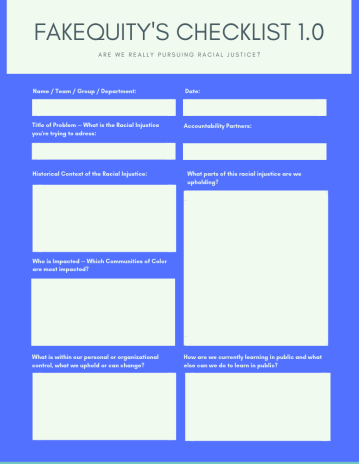
Fakequity Checklist 1.0Last week I asked you to do some homework. Did you identify what stage of denial or acceptance you and your organization are in with upholding the opportunity gap?
Once we can admit our organizations are upholding systemic racism, we can start looking for the root causes of the problem. This is going to be the start of a list, but not an exhaustive list.

Only a Single Lever: Changing the narrative is important, but a narrative change alone doesn’t dismantle systemic racism. It can be an important pivot point to get people to, in the words of organizational psychologist Adam Grant, “doubt the default” and engage in different conversations. But as we have seen with racial “equity,” talking about racial equity is not the same as implementing racial equity (#fakequityoriginstory). Narrative changes without also changing decision-makers and approaches, still upholds the status quo of systemic racism.

Ignoring the Impact of History: Too many people and organizations ignore or don’t make explicit connections to historical practices of forced assimilation of Indigenous Peoples through boarding schools, enslavement of Black people, and segregation of all people of color in education to why we currently still have systems where whiteness is still the standard. In the United States, we need to acknowledge that education has been weaponed as a tool to oppress people of color, especially Native and Black people. If we don’t make these explicit links, we uphold the implicit racist narrative that schools have mostly white leaders, white teachers, white curriculum, white norms because white folks are superior. Or white folks have been here longer. Or that the pervasive whiteness in our system is normal. All these statements are false, widespread unconscious beliefs that uphold racial injustice.

Dominant Society [Whiteness] Appropriation: Using the Closing the Opportunity Gap narrative has become the safety pin/easy version of performative organizational racial equity work. The origins might have been rooted in racial justice, but the appropriation of the term by mainstream organizations from school districts to philanthropy has watered down this term. It is like watching the same people who told me kimchi smells now making a fortune off selling their “more palatable version of kimchi.” And now, this new trendy and profitable version is more recognizable and popular than the authentic, smelly kimchi. #appropriation

Same Ole’ Tools that Use Whiteness as the Standard: My main argument around why “closing the achievement gap” is not racial justice is rooted in the fact that we continue to use the same ole’ tools. The continued obsession over standardized test scores and graduation rates as the indicators for “closing the opportunity gap” keeps our misdirection guided by whiteness as the standard. Before I get a lot of nasty notes, I am not making a statement about the usefulness of standardized testing (although I could), I am making the statement that using standardized test scores as an indicator of “closing the opportunity gap” keeps our strategies and approaches focused on “fixing” kids of color to meet this standard set to whiteness. It is also a standard that uses mostly East-Asians as a model minority tool to uphold this racist standard. This cannot be called racial justice work. If your closing the opportunity gap work is fixated on standardized test scores as the main or even primary indicator, we should not be calling this racial justice or racial equity work. Likewise, if your organization relies heavily on [read: white] evidenced-based programs, [read: white] promising practices, and [read: white] evaluation tools, you are using tools that uphold white supremacy and racial injustice.

Individual Support vs Disrupting Systemic Patterns: Somewhere in the national conversation, we have established an overdeveloped muscle to talk about individuals and an underdeveloped muscle to talk about systems. This is how this plays out in the “opportunity gap” conversation. It has organizations focused on meeting “individual student needs” and believing this is racial equity, as if being racialized Black or Native alone creates an individual need for a student that we need to “fix.” This is another of the roots of racism; the false narrative that race creates biological differences that we can attribute to the societal gaps we see. The continued, albeit mostly implicit, false belief that people of color are inherently and biologically inferior. Being racialized has nothing to do with individual effort, it has everything to do with unfair policies, practices, and narratives. Want to hear real examples of systemic racism in education, check out Start Up Podcast’s Success Academy 7: The High School Episode.

Racial justice provokes us to understand and change the dominant white systems that create these patterns of disproportionate outcomes. Differentiating for an individual student based on interest, needs, or culture is not unimportant, it is just not racial justice. Racial justice looks at broad patterns of disproportionate outcomes by race and changes the system for all, yes even white folks will benefit from systems that don’t constantly center whiteness. Specifically, it asks us to acknowledge we have education systems that have mostly white decision makers, mostly white teachers, mostly white curriculum, mostly white cultural norms, and mostly white kids “succeeding.”Racial justice asks us to not make excuses for this system, to not continue to push an education system that is rooted in white supremacy. Racial justice work is a movement towards real, specific, and tangible changes to create systems (leaders, teachers, curriculum, norms, etc.,) that don’t have these predictable patterns by race. If you want more on shifting from thinking about individual support to identifying systemic patterns, check out this article The Achievement Gap vs. The Justice Gap: Race vs. Redemption.

Required, Not Desired: Seek, compensate, and follow the wisdom and leadership of the people most impacted: communities, families, and students of color, especially, within Indigenous, African-American, Latinx, Pacific Islander, and Southeast Asian communities.

So how can we get closer to racial justice in education? We need to engage and support power from within communities of color who are farthest from the current default white system. Communities of Color are context and content experts in how the system is broken AND experts on proposing new ideas and ways to test and try. We need to seek, compensate, and follow the wisdom and leadership of the people most impacted: communities, families, and students of color, especially, within Indigenous, African-American, Latinx, Pacific Islander, and Southeast Asian communities.

This work needs to be required, not just desired. And, if you are reactively thinking, well show me what that looks like, I gently remind you that there is no such thing as an easy answer. We need to continue to engage in the hard work. But we do have numerous examples of how our communities of color have come together to set our own educational standard, they are just not usually publicly funded or deemed a “best practice” by whiteness. Consider some of these examples:

We are talking about communities of color, not individual people of color. One person or even two people of color cannot and should not “represent” the vast array of different racialized experiences. Too often white systems tokenize or two-kenize – a phrase that captures when we have two, not just one token – it is a phrase I heard on a podcast (I can’t remember the name of). All the examples above bring a specific racial (or ethnic) community or a coalition of communities of color together and allow us to show the complexity and humanity of our communities. Although we may be connected by race, our racialized experiences are complex due to other factors of identity such as class, gender, age, sexual orientation, faith, disability status, immigration status, language, etc. This diversity of racialized experiences will never be recognized if white systems continue to tokenize or two-kinize one or two people, continuing to uphold racial injustice. We can do better. We must do better if we want to pursue racial justice.

If you’d like to apply some of this framing to work outside the “closing the opportunity gap” narrative, try using this simple checklist with your team, co-workers, organization. It is inspired by the book, The Checklist Manifesto. It is a “read and do” list.

We’ve created a Fakequity Checklist 1.0 to help guide you through the checklist thought process. Like all toolkits and checklist, it is only as useful as the time and effort you put into it. Print out several copies, mark them up, rewrite, analyze, think, and write it up again. Share what you’re learning with others and have some deep conversations with accountability partners about the problem to get to better results.

Since PDFs aren’t always screen reader friendly, here is the text of the worksheet:

  • Name / Team / Group / Department – be race conscious
  • Date
  • Title of Problem – What is the Racial Injustice you’re trying to address?
  • Accountability Partners
  • Historical context of the racial injustice
  • What parts of the racial injustice are we upholding?
  • Who is impacted – Which Communities of Color are most impacted?
  • What is within our personal or organizational control, what are we upholding or what can we change?
  • How are we currently learning in public and what else can we do to learn in public?
  • Identify the societal systemic levers that uphold racism. Be specific to the racial injustice identified on page 1 (of the worksheet)
  • Identify our organizational systemic levers that uphold racism, be specific?
  • Document the required processes and approaches to seek out, compensate, and follow the lead of Communities of Color most impacted by the racial injustice — be specific. DON’T TOKENIZE. Is compensation for BIPOCs in your plans?
  • Notes, comments, reactions from accountability partners.

I am testing this new checklist to practice learning in public. If you use it, let us know how it works for you. Maybe we can write a post sharing the way people used the checklist and propose a next draft to test and practice using.


Thank you to our Patreon subscribers who help to keep the blog going: Adrienne, Aimie, Ali, Alissa, Amy, Amy R., Andrea, Annie, Annie G., Ashlie, Ben, Brooke, Brian, C+C, Calandra, Carolyn C., Carolyn M., Carrie, Carrie S., Chandra, Chelsea, Claudia, Cierra, Clark, Crystal, Dean, Denise, Denyse, Donald, Edith, Elena, emily, Erica, Erica R.B., Erin, Evan, eve, Freedom, Greg, Hannah, Heather, Heidi, Heidi and Laura, Heidi S., Jake, Janis, Jean, Jennet, Jennifer M., Jennifer T., Jessica, Jillian, Jody, John, Julia, Julie Anne, K.T., Kari, Karen, Katheryn, Kathi, Katie, Keisha, Kelli, Kristen, Kumar, Laurel, Laurie, Lisa, Lisa C., Liz, Lori, Lynn, Makeba, Maura, McKenzie, Megan, Melissa, Michael, Michelle, Mikaela, Mike, Milo, Minesh, Miranda, Miriam, Misha, Molly, Nathan, Nicole, Norrie, Paola, Priya, Rebecca, Rise Up for Students, Robin, Ruby, Sarah, Sarah S., Sean, Selina, Shannon, Shaun, Shawna, Shelby, Stephanie, Stephanie S., Tana, Tara, Terri, and Vivian. If I missed anyone my apologies and thank you for your support. Support the blog by becoming a Patreon supporter.

If you subscribe to the blog, thank you. Please check fakequity.com for the most up to date version of the post. We often make grammatical and stylistic corrections after the first publishing which shows up in your inbox. If you would like to subscribe there is a sign-up box on the right sidebar (desktop version). 

Closing the opportunity gap is NOT racial justice

By Heidi K. Schillinger

KateDeCiccio-AmandaGorman-WeTheFuture

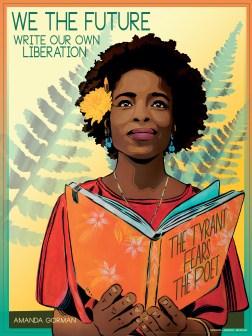
We the Future Write Our Own Liberation. Artwork from Amplifer by Kate DeCiccio

Okay, Peeps, It’s Time to Admit “Closing the Opportunity Gap” is Not Racial Justice or Racial Equity.

I’m glad you’re intrigued enough by the title to keep reading. You’re a fakequity fighter. You wouldn’t be here if you weren’t open to trying on a different perspective, right?

Commitment to Learning in Public

I’m embarrassed to say, it’s been about a year since I last wrote a Fakequity blog post. It’s been a long time. I have a long list of excuses, some more valid than others; a lot of life changes, a lot of Korean dramas, a lot of miles on my bike. Recently, I asked myself why I have such a hard time putting my ideas out in writing. My initial thought was I feel more at ease expressing myself through speaking. That made sense, I speak to groups about racial equity on a regular basis. So, I went on this quest to see if I could start a podcast. Attended a podcast conference and found out it is more complicated than I anticipated.

I haven’t given up on a podcast, but I realized that if I am being honest with myself, one of the reasons I don’t blog a lot is because I have perfectionist tendencies. I want to fully think through my ideas, consider all the potential resistance, and all the potential missing perspectives before putting my ideas out in public. I think these perfectionist tendencies come from adoption trauma, learned behavior as a woman of color who is constantly challenged to defend my ideas, and from the infection of white supremacy that asks us all to try to aspire to unrealistic expectations such as perfectionism.

After a lot of internal dialogue, and sparked by listening to the podcast, All My Relations, I decided I need to make a stronger commitment to learning in public. One of the All My Relations hosts, Dr. Adrienne Keene, frequently talks about “consenting to learn in public.” (Side note, if you haven’t checked out the All My Relations podcast, please do. They describe it as “a podcast to discuss our relationships as Native peoples– relationships to land, to ancestors, and to each other.”) 

Here is what I realized. I am constantly evolving. My ideas are constantly evolving. I develop drafts and drafts in my head while I am riding my bike. I am constantly being influenced by other people’s ideas, questions, and perspectives. I am guessing I am not alone, and I need to model the vulnerability of learning in public that I am asking other people to make. So here we go.

The Admission: I Uphold Systemic Racism. I Uphold White Supremacy.

Yes, you read that correctly. I am making the admission. Even as a woman of color I uphold systemic racism. I fall easily into the default ways of whiteness that are rewarded in our system. I am asking you to make this admission too. No, this is not a “we are all equal” statement. People of color, especially Black and Indigenous Peoples are disproportionality impacted by these systems, but we can all uphold systemic racism.

This might be the hardest part of undoing systems of racism, the admission phase. Here is how this works as it connects to the “opportunity gap” narrative. What stage of denial are you and your organization in right now?

  • Straight Up Denial: Racism doesn’t exist (anymore). All this emphasis on the “Opportunity Gap” or “Achievement Gap” or whatever you want to call it is reverse racism [read: against white people]. What about all [read: white] kids? What about poor [read: white] kids? What about my [read: white] kid?
  • Fakequity Denial: No, my organization has worked a long time to switch our language from “achievement gap” to “opportunity gap” [read: but everything else stays the same; same mostly all white decision makers, same mostly all white designed “evidenced based” programs, same mostly all white framed evaluation tools, etc.] and we are now on the path to racial equity.
  • Fakequity Fighter Denial: No, we have pushed so hard to change the narrative from “achievement gap” to “opportunity gap.” I read [the 2012 article], Please Stop Using the Phrase ‘Achievement Gap’ and changed my framing. We’ve even pushed philanthropy and government to start using the phrase opportunity gap. No. No. . . .Okay, maybe the phrase has gotten appropriated, maybe people changed the words but not the [mostly all white] decision makers. Maybe people are still funding and pushing “promising practices” asking students of color to change by developing grit, studying harder, etc. rather than changing the systems. Maybe I am, unintentionally, supporting approaches that ask students of color to learn how to survive in education systems that have mostly all white decision makers, mostly all white teachers, mostly all white curriculum, and mostly all white cultural norms.
  • Acceptance: Yes, it me. It is my organization. We are pushing programs, approaches and processes under the banner of “closing the opportunity gap” that uphold systemic racism and white supremacy.

Does the resistance sound familiar? It is hard to confront and reflect on how we operate and to realize we uphold practices we claim to be working to undo. Have you worked through your resistance?

Are you ready to make the admission and move onto identifying the problem? Next week I’ll share more about how closing the opportunity gap is not racial justice. Your homework for the week is to identify which level of denial you or your organization is in, and to identify ways you’re upholding systemic racism.


Thank you to our Patreon subscribers who help to keep the blog going: Adrienne, Aimie, Ali, Alissa, Amy, Amy R., Andrea, Annie, Annie G., Ashlie, Ben, Brooke, Brian, C+C, Calandra, Carolyn C., Carolyn M., Carrie, Carrie S., Chelsea, Cierra, Clark, Crystal, Dean, Denise, Denyse, Donald, Edith, Elena, emily, Erica, Erica R.B., Erin, Evan, eve, Freedom, Greg, Hannah, Heather, Heidi, Heidi and Laura, Heidi S., Jake, Janis, Jean, Jennet, Jennifer M., Jennifer T., Jessica, Jillian, Jody, John, Julia, Julie Anne, K.T., Kari, Karen, Katheryn, Kathi, Katie, Keisha, Kelli, Kristen, Kumar, Laurel, Laurie, Lisa, Lisa C., Liz, Lori, Lynn, Makeba, Maura, McKenzie, Megan, Melissa, Michael, Michelle, Mikaela, Mike, Milo, Minesh, Miranda, Miriam, Misha, Molly, Nathan, Nicole, Norrie, Paola, Priya, Rebecca, Rise Up for Students, Robin, Ruby, Sarah, Sarah S., Sean, Selina, Shannon, Shaun, Shawna, Shelby, Stephanie, Stephanie S., Tana, Tara, Terri, and Vivian. If I missed anyone my apologies and thank you for your support. Support the blog by becoming a Patreon supporter.

If you subscribe to the blog, thank you. Please check fakequity.com for the most up to date version of the post. We often make grammatical and stylistic corrections after the first publishing which shows up in your inbox. If you would like to subscribe there is a sign-up box on the right sidebar (desktop version). 

Cake time

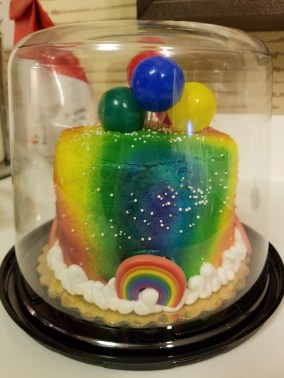
20180217_181958It is time to celebrate! Thank you to the 102 people who are Patreon subscribers to the blog. I wrote when we hit 100 Patreon supporters we’d celebrate with a virtual cake, so here is our cake. I also decided we need to do more than just celebrate with a picture of a cake, we’re going all in – a whole blog post about cakes in different cultures.
I asked friends to weigh in on the topic. My friend Bao asked if I was writing just about cakes or more broadly sweets since cakes come in many different forms. There are sweet cakes and savory cakes, cakes you eat in the morning and some you eat at night. The world of cakes and sweets is rich and deserves a post.

Cakes and Cultures

Many have studied cultures and have determined the essential elements that define cultures – language, religion, values/attitudes, social structure, communication, and some people list food. I believe culture defines food, and vice versa food defines culture. How we celebrate with food is also a defining part of a culture. Many cultures have their own versions of sweets and cakes. Bao mentioned the Vietnamese word for cake is bánh, which is part of the name of bánh mi — the name of Vietnamese sandwiches.

fruit cake

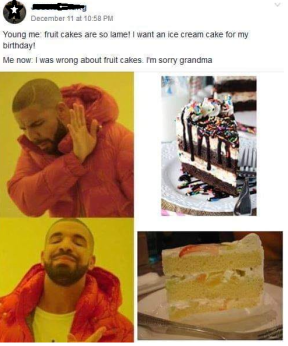
Ice cream cake vs. Asian fruit cake –h/t Stacy for finding this on Facebook

During mid-autumn festival, harvest time, mooncakes are popular treats in the Chinese culture. These round cakes symbolize togetherness and reunion and are often served with tea. Stacy, a friend, said she coveted the mooncakes with the salty egg yolks, and through her church, she discovered other types of mooncakes – red bean paste, lotus paste, and even durian. Some other Chinese sweet and savory treats are niin go, rice cake cut into diamonds, and the beloved Asian/Chinese fruit cake – a white cake with layers of fruit in the middle. If you’ve had the fruit cake you’ll remember it – not sugary-sweet like Costco frosting filled cakes which is disappointing as a kid, but delicious and appealing as an adult.

One of the best pound cakes I ever had came from an African American friend. She took care of my babies and only later did I discover Miss Nicee, as the kids call her, is a baker on the side. Her pound cakes are nothing like Sara Lee’s from the frozen food aisle at the grocery store. Her pound cakes are buttery smooth and just the right amount of sweet. Caramel cake, soul food, is on my list of cakes to try – all of that caramel soaking into that cake, deliciousness on a plate.

My friend recently had a baby who is about to turn 100-days old. To mark the occasion they’ll be eating and making Baekseolgi-tteok 백설기떡, a white steamed cake. According to my friend, it is a delicious treat, but very cumbersome to make since it needs to be steamed. The tradition is the more people who share in the cake eating the longer life the baby will have. I want her baby to have a long life so I volunteer to eat a bite or two.

Not Sweet, but still Cakes

20180408_112854

Okonomiyaki — so delicious. Photo copyright Erin Okuno

At another time we’ll have to explore pancake culture. For years I’d dutifully eat an American style Bisquick made pancake because someone took the time to make it and to feed me. Pancakes were never my favorite, I’d much prefer savory eggs or something sweet like a piece of leftover cake for breakfast. A few years ago, I read a Seattle Times article that I now can’t find, about the best pancakes in Seattle. The food writer looked at pancakes from many cultures and regions such as Chinese scallion pancakes, crepes, Dutch baby pancakes, etc. Some of my favorite pancakes are Japanese okonomiyaki, a pancake with cabbage and savory elements cooked into it, and Korean pajeon.

The not sweet part of sweets is looking at how colonization, and sugar, in particular, have shaped our world views. I won’t go into detail on this since this is a more celebratory blog post thanking many of you for supporting the blog, but in researching the topic I had to stop and consider how sugar has shaped our BIPOC communities. For Japanese in Hawaii, including my family, my ancestors most likely immigrated from Japan to Hawaii to work on the sugarcane or pineapple fields. The poverty and economics of working the fields were hard. Many Africans were stolen from their motherland and enslaved on sugar fields. Gabe, who is Native American, reminded me of the legacy of how the US government provided commodities and food that wasn’t indigenous thus changing food culture for many Indigenous people. Recently I heard from a food justice organizer about how berry pickers in Washington organized and went on strike over poor working conditions in the strawberry fields. Food justice is integral to being a whole and just society.

Sweet!

Thank you to everyone who supports the blog by being a Patreon, subscribing, or reading and sharing the blog. The fakequity team enjoys hearing from you and knowing so many of you are working on undoing the legacies of racism in your own ways and in your communities.


Thank you to our Patreon subscribers who help to keep the blog going: Aimie, Ali, Alissa, Amy, Amy R., Andrea, Annie, Annie G., Ashlie, Ben, Brooke, Brian, C+C, Calandra, Carolyn C., Carolyn M., Carrie, Carrie S., Chelsea, Cierra, Clark, Dean, Denise, Denyse, Donald, Edith, Elena, emily, Erica, Erica R.B., Erin, Evan, eve, Freedom, Greg, Hannah, Heather, Heidi, Heidi and Laura, Heidi S., Jake, Janis, Jean, Jennet, Jennifer M., Jennifer T., Jessica, Jillian, Jody, John, Julia, Julie Anne, K.T., Kari, Karen, Katheryn, Kathi, Katie, Keisha, Kelli, Kristen, Kumar, Laurel, Laurie, Lisa, Lisa C., Liz, Lori, Lynn, Makeba, McKenzie, Megan, Michael, Michelle, Mikaela, Mike, Milo, Minesh, Miranda, Miriam, Misha, Molly, Nathan, Nicole, Norrie, Paola, Priya, Rebecca, Rise Up for Students, Robin, Ruby, Sarah, Sarah S., Sean, Selina, Shannon, Shaun, Shawna, Shelby, Stephanie, Stephanie S., Tana, Tara, Terri, and Vivian. If I missed anyone my apologies and thank you for your support. Support the blog by becoming a Patreon supporter.

If you subscribe to the blog, thank you. Please check fakequity.com for the most up to date version of the post. We often make grammatical and stylistic corrections after the first publishing which shows up in your inbox. If you would like to subscribe there is a sign-up box on the right sidebar (desktop version).