Before we start I want to honor the passing of Bob Santos. Uncle Bob was one of the Four Amigos or Gang of Four (Asian, Native American, African American, and Hispanic/Latino), who modeled how to work cross racially and cross culturally. The Four Amigos united communities of color and shaped Seattle into the city it is today – a place many of people of color call home and feel connected to because our cultural bonds are intact and we’ve held on a sense of place. While I didn’t know Bob, I know I wouldn’t be where I am without his work. I will do my part to honor his legacy, although I will have to leave the karaoke singing for which he was known to others. Rest in peace and power.

Original Thinking
I recently took a trip to my home state. While packing I grabbed the book Original by Adam Grant and threw it into my carry on – beach reading right? Nah, I finally cracked it open on the flight back when the kid hogged the tablet with all of the downloaded shows. In reading the book, which wasn’t about race or equity, I started thinking about how to apply the ideas to racial equity work. Several chapters in I had the thought “we need original thinking around race in order to change” (albeit this wasn’t a wholly original thought, many others have thought it before). The old and current systems aren’t working for communities of color. We need to nurture and undo traditional power structures that stifle ‘new’ thinking and doing.
In the book the author talks about groupthink and how it kills original/new ideas. I agree, I see it all of the time when working with government agencies and larger organizations. Where I don’t see groupthink happening as much is within coalitions centered in communities of color (it does happen but I see it less). I might be biased here since I work for a coalition centered in communities of color, but I can say with certainty the conversations that take place in our coalition meetings happen because we center our work in communities of color and we talk about race.
Well attuned coalitions bring diverse people together, building towards a common purpose and goal. Divergent thoughts are allowed and explored so we can emerge with better results and a more united front. In other words, the policy work or end product has more equity built into it because more people of color have a chance to weigh in, play with the idea, and the outcome is a more original idea, not a boilerplate product coming out of a monolithic group. While it sounds easy, in reality it is harder to do. It takes a lot of time and energy. Timelines are blown, we have to slow down and redo work to get it more right, coalition work gets messy, people’s feelings sometimes get hurt, we have to report to superiors that work is delayed, but in the end the work is right.
How to Get a Coalition Right – Stopping the Echo Chamber
Coalitions centered in communities of color serve as places where communities of color can emphasize our collective values over the procedural rules that continue to hold us in boxes and uphold institutional racism. As the author of Original (the book) shares, “Rules [procedures] set limits that teach children [and adults] to adopt fixed views of the world. Values encourage children [and adults] to internalize principles for themselves.” When we talk about our values around community, culture, and race we’re getting to the heart of who we are and the type of community we want to create for ourselves. This is so much more interesting than talking about the things talked about at so many mainstream task force meetings.
Focusing on values versus procedures is hard for people who are used to movement and action. Constantly doing versus asking why we are doing something different or trying something new is a way we uphold institutional and systemic racism – the doing without attributing it to values keeps the same broken actions from repeating itself. As an example, why do we constantly send out online surveys to ask for opinions? We can say the value is to hear back from the community, but is this how the community wants to be heard – on paper asking pre-scripted questions, probably not. This type of opposition may be more keenly heard within a coalition than in an insular meeting.
Investing in Coalitions
Investing in coalitions can happen in so many different ways. One of the best ways is to join a coalition – invest time. If you have to give something up to make time for coalition work, look at your calendar and decide which meetings are white/mainstream echo chamber meetings – in other words which ones are a chorus of the like-minded and you’re not hearing anything new. The people at the ‘echo meetings’ may be great but you can still see them at lunch or at happy hour. Instead invest in coalitions that are making a difference for communities of color — open doors to a great supporter, bring new people into the coalition, for our white partners and allies attend to your white coalition partners so their needs are met (outside of the coalition meeting) and they don’t overshadow the coalitions values and focus. Coalitions take work to sustain and thrive. The end result will be better returns on your investment of time and energy than going the old easy route.
Posted by Erin Okuno
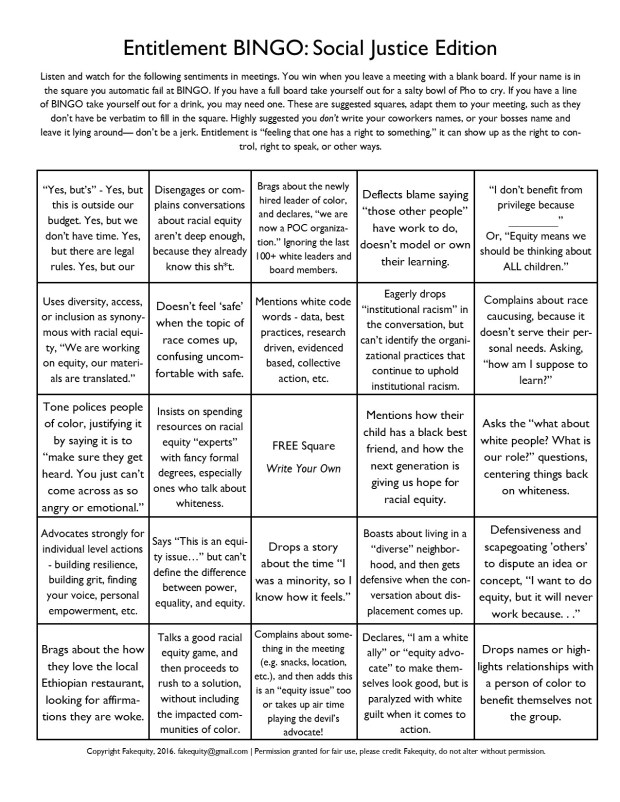
 When Fakequity first started I periodically posted Spot the Fakequity questions on our Facebook page. I’d post an example and ask our Facebook community to write answers about where the fakequity showed up. Correct answers would win a virtual onion as a prize. We’ll explain why an onion at the end to keep you reading. I thought we’d play more Spot the Fakequity. Here is how it works, read the short statement and look for where fakequity (fake equity) shows up.
 As an avid procrastinator I often wander over to Facebook to read what is happening in my online network. Over the past few years I’ve noticed crowd sourcing for donations and support has become more commonplace and an easy way for people to ask and receive support from each other. A few weeks ago I saw a GoFundMe campaign in a group page. Sharon (not her real name) had a piece of business equipment stolen. The theft crippled her business and she didn’t have extra funds for a replacement. She humbly and reluctantly posted the online campaign page. Sharon is well-networked in her neighborhood, likeable, and her family while not rich is stable and comfortable. Within a few days she had made significant progress towards the campaign’s financial goal.
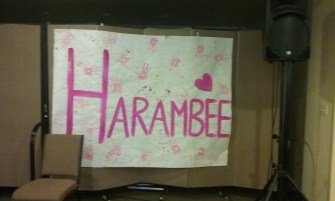 This morning I got a treat. I spent the morning watching elementary age students participate in their Freedom School’s harambee. Translated from Swahili harambee means to ‘let’s pull together.’ The morning harambee included ridiculously energetic songs and dance, chants, and call and response. To create a greater sense of community they include recognitions that sound like this (read this in your loudest voice): “Hey, I got a recognition!” “A what?” “A recognition! I want to recognize you for being a fakequity fighter!” Let’s go fight more fakequity in community engagement.
 I’m on a train northbound from Portland, OR. I love visiting Portland: tax-free shopping, food carts, consignment shops, and wandering around Powell’s City of Books. Being in a new city often crystalizes or magnifies things differently for me. One part of racial equity work I thought more deeply about while in Portland is how we identify ourselves and who gets to control that narrative.
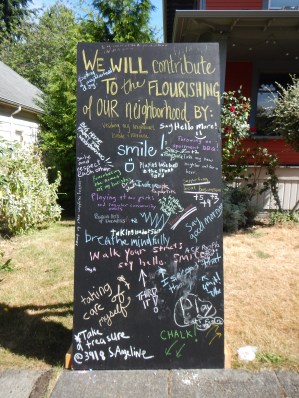 introduce themselves. The online group has been together for a while, but often times posts are transactional or asking for advice on parenting situations. I wanted to pause and find out who is in the group, relationships can’t form if we don’t know who is there. Allies become allies when we know who is around us and we understand each others backgrounds.