 When Fakequity first started I periodically posted Spot the Fakequity questions on our Facebook page. I’d post an example and ask our Facebook community to write answers about where the fakequity showed up. Correct answers would win a virtual onion as a prize. We’ll explain why an onion at the end to keep you reading. I thought we’d play more Spot the Fakequity. Here is how it works, read the short statement and look for where fakequity (fake equity) shows up.
Spot the Fakequity: In an urban fire department at a Mayor mandated Race and Social Justice training, a white battalion chief says “We’re all good in this department. Look at the diversity we have here.” His department is majority People of Color (poc), leadership in this department is mostly white assistant chiefs, the Fire Chief (overall head who reports to the Mayor) is an African American, and the fire department’s mandate is they serve everyone in the city – anyone who calls 911 receives care, anyone who calls for prevention services receives services based on order received. The battalion chief boasts to his bosses how great the prevention services are in serving communities. Can you spot the fakequity?
Imagine being a firefighter of color sitting in that room wearing a blue uniform shirt and looking to your right to see your poc brothers and sisters in blue, then hearing the statement “I see diversity in the room” and looking to your left and seeing all of the ‘white shirts’ with badges who hold leadership. Not a great feeling realizing your boss doesn’t believe in your leadership potential, nor is he open to understanding his role in upholding institutional racism. Fakequity is in the battalion chief not recognizing the power imbalance in the room.
Fakequity also shows up in the prevention services they offer. By having a first-come first-serve model the department is practicing equality. Equity would be coming up with a way to prioritize low income communities of color would demonstrate racial equity.
Spot the Fakequity: The director of an education advocacy organization says “I have a focus on supporting all children; black, brown, and white children – they all need our help.” Can you spot the fakequity?
It is tempting to say “Oh they are practicing equity since they support children of color.” Nah, they are drooling fakequity. Racial equity work is about acknowledging children of color have different needs to be made whole, and to reach a fair starting point. The word all is dismissive of the experiences of people of color. All says we are all in the same group and we all have the same access to programs, information, leadership, etc. We need to recognize not all students need the same resources. Equitable practices is creating systems to target resources to students of color who need support. There is also a problem with the word ‘help.’ Communities of color do not always need help. We need access to resources, a recognition of opening and sharing power, and to be seen and understood.
I also smell fakequity in failing to acknowledge Asian, Pacific Islanders, and Native American students. Too often Asians, Pacific Islanders, and Native Americans (and probably a few other race groups) are left out conversations about racial inequities. Thanks for making us invisible.
Spot the Fakequity: A board member (policymaker) says “I just watched a great TED Talk on bias. I now see the importance of professional development for teachers on addressing bias in our programs. Teachers are the ones who are with our students everyday.”
I once heard the joke the TV show Law & Order is always on somewhere in the world. The desire to ‘fix’ things through trainings is like Law & Order – its everywhere. We like to send people to trainings to fix things. I’m guilty of this as well, earlier this week I co-presented at a family engagement conference on our coalition’s work with family engagement data. But it’s too easy to read a conference description and think “Wow this sounds amazing! I need to send staff to learn all about race. They’ll come back ready to go!” Just as you can’t solve a complex crime in one-hour (unless you’re Jerry Orbach on Law & Order), professional development alone won’t solve all of our classroom or program problems. Fakequity is for policymakers to think they can take the easy road to fixing problems.
Systems level solutions are also needed to achieve greater and more long lasting racial equity solutions. When we look at the systems in place holding students of color back we begin to really ask harder questions rather than the Band-Aid solutions of sending people to trainings. Creating more equitable systems doesn’t have to be overwhelming or hard, but it does take intentional work to look for why people of color aren’t thriving in the same system where white people thrive.
Fakequtiy vs. Equity
Did you spot the fakequity in the examples above? Fakequity shows up in wanting to do the easy stuff and not looking for the larger inequities, doing the harder work in engaging the community, and basically in being lazy in thinking and actions. Equity work is challenging and requires us to dig deeper and search for solutions. Racial equity work requires us to talk about race which makes many people uncomfortable. The rewards are there when we get our work right.
Legend of the Fakequity Onion
Around the time I started the Fakequity Facebook page, my colleagues James Hong, Heidi Schillinger, Jill Mangaliman, and I spoke to social work students at the University of Washington. A few days before my officemate Laurel Saito brought a gigantic box of onion from a farm near her parent’s house. As a joke and a way to share the onions I packed some for our presentation. When we got to the class James, Heidi, Jill, and I rewarded students who came up with the best answers with an onion. Onions were pitched all over the classroom. One student said “I’ve never wanted an onion so badly before in my life,” sadly he didn’t win one for saying that. This is how the fakequity onion came to be.
 As an avid procrastinator I often wander over to Facebook to read what is happening in my online network. Over the past few years I’ve noticed crowd sourcing for donations and support has become more commonplace and an easy way for people to ask and receive support from each other. A few weeks ago I saw a GoFundMe campaign in a group page. Sharon (not her real name) had a piece of business equipment stolen. The theft crippled her business and she didn’t have extra funds for a replacement. She humbly and reluctantly posted the online campaign page. Sharon is well-networked in her neighborhood, likeable, and her family while not rich is stable and comfortable. Within a few days she had made significant progress towards the campaign’s financial goal.
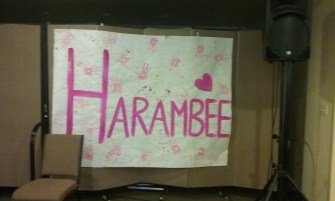 This morning I got a treat. I spent the morning watching elementary age students participate in their Freedom School’s harambee. Translated from Swahili harambee means to ‘let’s pull together.’ The morning harambee included ridiculously energetic songs and dance, chants, and call and response. To create a greater sense of community they include recognitions that sound like this (read this in your loudest voice): “Hey, I got a recognition!” “A what?” “A recognition! I want to recognize you for being a fakequity fighter!” Let’s go fight more fakequity in community engagement.
 I’m on a train northbound from Portland, OR. I love visiting Portland: tax-free shopping, food carts, consignment shops, and wandering around Powell’s City of Books. Being in a new city often crystalizes or magnifies things differently for me. One part of racial equity work I thought more deeply about while in Portland is how we identify ourselves and who gets to control that narrative.



 $100-million
 Bob was one of my all time favorite colleagues; he served as deputy director of a state government agency. Bob was a jokester and prankster. Our work together was epic, during one conference call my co-worker Sarah and I sat in her car in the pouring rain listening in as Bob and Joel laughed for 45-minutes about little things, we managed to focus the last 15-minutes to talk about creating a parent focused leadership program. One of the lessons Bob taught me is “Any time the word parent or community shows up on a committee assignment, run the other way.” His point was family and community engagement takes a different skill set to do and get right.
 FAKEQUITY