W.A.I.T. – Why Am I Talking?

8283288I learned a brilliant new acronym W.A.I.T. – Why Am I Talking? So many times I want to yell this in meetings, but restrain myself because I know it would be rude and then I would have to ask myself the same question “why are you yelling about talking?”

Often times we are expected and paid to talk. In the nonprofit, government, and philanthropic worlds we are expected to share our thoughts, advocate for communities, ask others to think about different angles, or at the very least ask a question about the topic to prove we’re paying attention and not thinking about the latest episode of House of Cards.

Yet, in talking we have to ask who are representing and are we the best ones to speak about a particular viewpoint or community. This is a question we should ask ourselves often. Are we speaking about a topic because we are ‘centered’ in the work or is our speaking up detracting from others. We should ‘pass the mic’ to others because they are closer to the topic and the most impacted by a disparity.

Pass the Mic Please
Recently Macklemore, a rapper, released a new song about white privilege. He’s gotten a lot of attention and accolades for talking about race and his place as a white man in the music scene. Others have criticized him for not ‘passing the mic’ to a person of color and using his influence to elevate the voices of other rappers and musicians of color. Is he aiding the cause or using his position of influence to take attention away from others. Could he use his influence to help launch an artist of color career instead of publishing a song that benefits mostly himself? Like Macklemore we have to ask ourselves these same questions in government, nonprofit, and community work.

In the nonprofit world we are rewarded for being in the room and speaking up. We are paid for bringing people together to help solve problems. We are in the middle, we are closer to the community and hopefully trusted by the community to understand what is happening and what is needed, but why are we talking and should we speak?

So… Why Am I Talking? Is What I Have to Say Interesting or Noise?
Several colleagues have shared stories of organizations and agencies that claimed to speak for communities of color but aren’t from communities of color. A colleague who is a leader of color took a meeting with a white advocate who claims to champion equity. As they talked over lunch, a rift emerged over what the term ‘equitable funding’ meant to both of them. As lunch continued the rift widened and became a chasm. Their definitions of equity were very different, my colleague believing in racial equity the other person believing more in equality AND she believed she had more of a right to speak about equity because of her experiences growing up poor and her ability to mobilize (via the internet) passionate ‘allies’ to testify and speak out on ‘equity issues.’ Is this new organization adding substance to the conversation about equity or is it adding noise and taking away from communities of color? Can they ‘pass the mic’ back to communities of color who are organized and already understand equity? The other group can take on another topic or be a good ally and support someone else’s agenda.

Another friend shared a story about leading a conversation about racial disparities and using data to show the gaps between people of color and whites in different sectors (e.g. environment, education, health, workforce, etc.). Midway through the conversation a white person took over the conversation to talk about how she felt the conversation was one-sided and the data wasn’t fair because she isn’t like other white people – she grew up poor and comes from a religious minority. Essentially the person hijacked the agenda and turned the meeting into a support group for herself thus taking the attention away from the important work of looking at racial disparities. My friend empathized her but it would have been helpful if she talked about the data and waited until after the meeting to focus on her feelings and process her feelings around race.

It is important for people and organizations to speak and to use our voices to amplify messages of racial equity. Speaking out about racism and dialoguing about race breaks down barriers and helps us understand one another, but we need to use our voices appropriately and in ways that elevates and supports people of color and those most impacted by disparities.

Think Before We Speak
As you W.A.I.T. to speak think about these questions:

  • Ask yourself why, why are you talking? Is what I have to say interesting, it is helpful, is it genuine or are you repeating what a person of color has already said? Are you pushing your own agenda versus amplifying the voices of communities of color?
  • Is your definition of equity the same as how communities of color define equity? When co
    mmunities of color say equity, we often mean racial equity, not equality, or worse investment equity. If it isn’t the same then don’t talk about equity, talk about your agenda and why it is important to you—but DO NOT evoke equity or I will hunt you down and buzzer you every time you misuse the word equity.
  • Can someone closer to the community or the movement speak more authentically than you? We need to use our positions and networks to open doors and close the gaps between policymakers, funders, and others who can influence decisions and the community– others can tell their own stories.
  • Ask yourself “If I must speak am I adding to the conversation or am I processing my own crap about race?” We all have to learn about race and sometimes we need to talk it out, but save that for happy hour and not the middle of a meeting.

Thank you to colleagues from Coalition of Communities of Color for sharing the acronym W.A.I.T. I think I’ve E.L.M.O. (enough, let’s move on) it thoroughly and ready to move to the next topic to blog about. 

Posted by Erin Okun
Lunar New Year- “Ally Organizations” See Your Fortune Here!

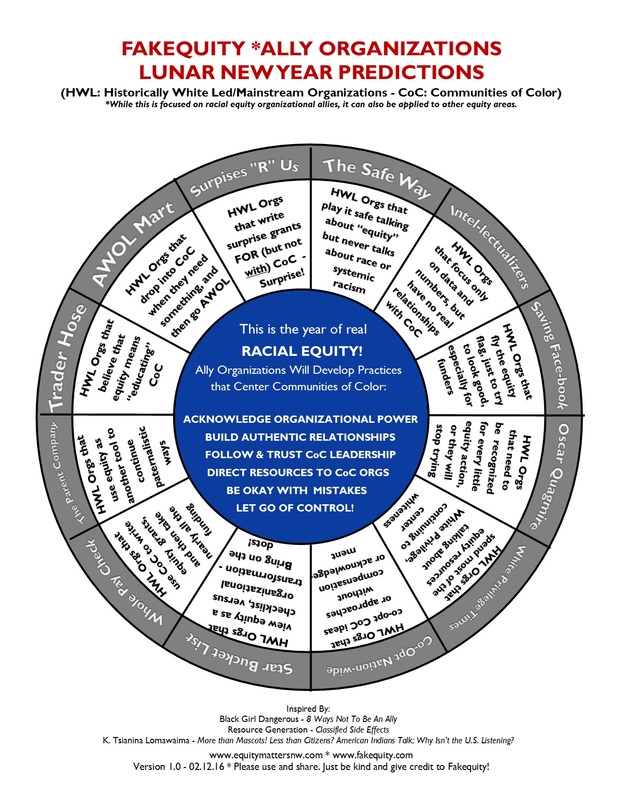
Happy Lunar New Year! The Fakequity team sends you well-wishes during the Chinese Year of the Fire Monkey. For many this is a time of the year where we look at our Chinese animal horoscopes and plan for the year ahead. Depending on the website you read you may either get a glowing prediction for the year or something draconian such as “If you are born in the year of the Horse you better buckle down and work hard because the year of the Monkey brings unexpected changes and you’ll lose all your money.”

We give you the Fakequity “Ally Organization” Lunar New Year Horoscope, or maybe it is Fakequity Horrorscope. Think of the wheel like the traditional 12 animals of the Chinese Horoscope. If your organizational practices fall into one of these Fakequity “Ally Organization” categories your fortune will be shown to you. The predictions are just predictions; will you and your organization fall victim to the prediction or work towards determining your own racial equity minded destiny? Your organization’s year is in your hands. The fortunes can be mitigated if you do the hard work of engaging with the community, using a racial equity lens, centering work in communities of color, continuing to learn about race and equity, and calling out fakequity.

Being a genuine racial equity ally organization is challenging, and the Fakequity team hopes that these predictions open up conversations for ally organizations to recognize and then quickly work to change (or avoid) some of these typical fakequity ally organizational practices. Missteps and challenges are part of this work, and because ally organizations are closer to power and control the (unintentional) blunders feel especially painful, and actually continue to uphold systems of racial inequity. While these predictions are focused on racial equity ally organizations, they can also be applied to other equity areas.

The predictions brought to you by Heidi S. of Equity Matters, Dr. Christine N. (who has a knack at reconfiguring words and serves as an honorary member of the Fakequity team), CiKeithia, and Erin. Leave a comment and tell us what you think of your predictions. If you would like a PDF emailed to you please contact fakequity@gmail.com.

9978481_orig

Beyond Checking the Box

1454706085

Beyond Checking the Box

In community outreach and engagement work, nothing invokes the concept of “Fakequity” more than when agencies (government and nonprofit) do it just to “check the box.”

While many agencies have gotten better and more intentional in outreach and engagement of low-income refugees, immigrants and communities of color – it’s astounding how much they still miss the mark by only seeking to mark that box.

Many agencies still do engagement with half-effort tactics such as inaccessible meetings; short or no timely community notice; translation/interpretation without context and support; duplicative surveying; online-only or email outreach; no follow through and more.

Whether for good PR (that photo opp!), appeasing a higher-up or positioning oneself for funding – to do half-assed community outreach and engagement just to be able to say that you did it is ultimately a waste of time and resources; and a detriment to building authentic community relationships based on trust, respect and self-determination.

The need for agencies to do better inclusive outreach and engagement is to ensure communities are educated, have access to and utilize public services; and where feedback, implementation; leadership and decision-making mechanisms exist to shape the policies and services designed to serve impacted communities.

As there are so many great grassroots organizations and agencies that do this work well, these recommendations really serve more like a “reminder” for opportunities to improve in these practices:

  • Successful engagement makes genuine efforts to maximize social-cultural opportunities to civic participation.Accessible locations; cultural competent technical support with translation, interpretation and facilitation; food, childcare and transportation are some examples of how to maximize participation from low-income refugees, immigrants and communities of color. Timely notice of opportunities for involvement and participation can’t be emphasized enough. Depending on the nature and urgency of the project, I’ve always tried to ensure that my outreach workers have 1.5-2 months to do their work with communities of color in-language for multicultural events. Understandably, there are urgent issues that come up short notice but it’s always a good rule of thumb to give advance notice as possible when attempting to gather diverse community members. Convenings should also be accessible in culturally familiar locations where communities feel more comfortable and at-home to enhance participation – specifically where communities live, work, play, worship, etc. such as a church, mosque, or frequented restaurant/business. Beyond translation and interpretation, limited English speaking (LES) communities often still need additional support to understand technical language and topics. Outreach workers that facilitate discussion in-language and transliterate feedback are critical to engaging LES communities.
  • Do the due diligent research and coordination on whether communities have already been engaged on that particular issue. I was recently reviewing grant applications for a foundation funding policy organizing and a few that I read proposed community engagement efforts to do a community survey on… housing. A topic that’s pretty much been surveyed to death. The fact that there is a local housing crisis and displacement (direct and indirect) is rampant shows the need for more action and implementation versus repetitive surveys. Contact other agencies and collect/coordinate whatever data and feedback was already received on that service or policy. Synthesize past feedback and develop strategies and solutions to use in your next survey or focus group to “check-in” with the community on whether those strategies resonate and can realistically arrive at solutions. This makes people feel that they were heard and that action steps and solutions are being developed to move forward in the process.
  • Report back, follow-up and follow through. Similar to the frustration of repetitive engagement – a huge peeve is when agencies never follow up on the status or results of what was done with the feedback. Or don’t follow-through on a request or action item. It’s this cycle of inaction that further disillusions communities from participating in surveys, focus groups or community meetings and advocacy. A must-do when executing a community engagement plan is to always build in time post-engagement and advocacy for reporting back to community members. Use the names and contact information collected (hopefully you did and you should if you didn’t) during engagement to reach them and inform them on the status, next steps or results of their participation.  The simple action of hearing back from an agency and knowing what was done with their feedback or how their participation made an impact shows respect for that person’s time, builds trust and a deeper commitment to civic engagement.

These “reminders” and recommendations are no means exhaustive and this list can be lengthy. Community engagement is about getting out there, getting to know people, listening, hearing, taking action and following through. The individuals that you talk to are not going to be your first and last point of engagement so make that effort to foster and grow that connection. Above and beyond community engagement, it’s always about building relationships and supporting spaces where impacted communities lead and self-define the types of services and policies that they benefit from; and implement in partnership with other agencies and institutions.

Posted by Cherry Cayabyab

Race Neutral? No Way. We Must Live our Values

I just came home from the Rainier Valley Corps‘ (RVC) community gathering. RVC is a leadership development organization focused on recruiting emerging leaders of color, and placing them with community of color focused nonprofits in the Rainier Valley (Seattle). RVC provides their Fellows with leadership training and skill development. The host organizations also receive capacity building support and an amazing Fellow to work with for a year. My organization, Southeast Seattle Education Coalition, host a Fellow – Mindy, our Fellow is fabulous, despite what she said on stage about my sending her to meetings I don’t want to go to—I would never do that, I call it exposure to leadership opportunities.

RVC is so successful because they are values and mission driven. While many organizations claim to be mission and values driven, few are rooted and connected to the community and live their values and grapple with how to practice their values as RVC. Everything about their organization exudes a commitment to their racial equity values. Their leadership, staffing and hiring structures, recruitment of their staff and fellows, programming, and way they operate can be tracked back to their values. I’ve also watched where the organization has faltered and strayed from their racial equity values, but their values around community and equity allowed them to adjust and recommit themselves to their mission.

No Such Thing as a Race Neutral Process
Recently I participated in an organization’s strategic planning process. The facilitator is well respected, knowledgeable, and understands organizational development, however she doesn’t lead with a racial equity lens. Her process is purposefully ‘race neutral,’ “which allows people to see a magnitude of possibilities which is necessary for re-envisioning work.” It was fascinating to watch how the race neutral process clashed with those who insisted on framing the process with race and equity. Anytime someone brought up race the comment was put aside; in the neutral process, race wasn’t named and didn’t have a place.

As we moved through the day, many of the participants questioned the assumption of how a race neutral process would benefit the organization and ultimately students of color. For too many students of color race is a predictor of success and outcomes. We pushed the organization and each other to think about values and to speak more openly about race and racial equity. We were asking the organization to live their racial equity values and to actualize it by being explicit and clear about how race fit into the planning process. We also challenged the assumption that a race neutral process would benefit children of color. On the positive side it was impressive to see younger colleagues step up and stretch their racial equity values by pushing for race to be included in the conversation. Parents in the room also spoke up and talked about how race impacted theirs and their friends experiences with educational systems. These stories and voices contain important information that can help with the planning process.

Organizational values need to be lived if they will have an impact, just documenting them doesn’t bring about change. Talk/writing with no action = fakequity.

How to Lead with Race and Racial Equity Values
In order for our work and organizations to succeed in closing racial gaps we need to acknowledge that race matters. We need to be bolder, transparent, and open about our commitment to racial equity. We need to name race, we need to talk about its impact on people, and we need to frame our organization’s commitment to racial equity work (not literally, although I give you permission to frame the Fakequity chart).

Leading with racial equity values helps us focus our work with communities of color. In my work we focus on race and we do our best to lead with race. At the start of our coalition meetings I devote time to talking about we operate our meeting and ‘live’ our equity value– openly talk about race, focusing on relationships, and recognizing that there are many different perspectives to learn from. By being clear about how we talk about race, we can then talk about race. Our conversations are different than at other tables, our conversations go deeper and faster because we are clear about our values and how we live our values. Rainier Valley Corps also leads with race and they are respected because of it.

By being clear about our values and how we work we center our work more keenly to the needs of communities of color, and people who are uncomfortable with talking about race tend to self-select out. Partners are willing to work with us because they know where we stand and how we prioritize our work.

Five Steps to Lead with Racial Equity Values
Living our values around race and equity is simple, but at the same time not simple. Start with the simple parts, then begin to embed the harder parts and soon you’ll be an Equity Champion.

1. Name your values and describe how you will work towards them: If equity is one of your values, what does this actually mean? How will your organization practice equity? Make a list of the synonyms that mean equity. We did this at my organization and it allowed us to clarify what words meant to each of us. There can be just as many definitions of equity as there are people in your meeting.
3299697.jpg
2. Tape your values to your desk, make a note in your smart phone, put them as a footer on your agendas, make a modern art piece depicting the values—It is really easy to forget all of our values, but the words have meanings and are only as good as how we live and practice them. I turned our values into ice, seriously: Integrity, Community, Courage, and Equity — ICCE. I’m going to make an equity ice sculpture.

3. Align and partner with those who share your values—This one gets a little harder. Living our values means saying yes, and saying no. Aligning an organization’s work to align with racial equity means we have to do things differently. It can be as simple as changing the wording on a document to be more inclusive and then clarifying how to be more inclusive, to the harder steps of questioning a funder’s priority to racial equity and potentially saying “thank you for the opportunity to apply for your funding, but our racial equity values are not aligning with your priorities, let’s revisit this next year.”

4. Admit when you’ve strayed from your values—There are times where the bright and shiny object distract us away from our values. It is important to admit when we’ve chased the wrong shiny object.

5. Values can be fun—Values don’t have to be dry and seen as limitations, they can be fun and allow your organization to embrace exciting work. In my organization we practice our community value by hosting Final Friday Lunch (our colleagues at Vietnamese Friendship Association co-host the lunch). On the last Friday of the month we open our office and invite people to brown bag lunch with us. It is a way to grow our network, support each other, vent a little, and unwind. At today’s lunch we chatted with a colleague in the housing sector and learned what is going on in the ‘hood. This networking benefits us all.

Posted by Erin Okuno

How to begin to ‘do equity’ when you’re not ‘doing equity’

A few years ago several friends and I had a conversation about how to ‘do equity’ when an organization isn’t ‘doing equity.’ In other words, someone in her organization heard the buzz word ‘equity’ and mandated it, but hadn’t figured out how to adjust the organization to be more community centered and aligned to the principles of equity.  My poor friend Tyler was frustrated her colleagues expected her to be the ‘equity expert.’ So we had a huddle (a.k.a. we went to happy hour) to whine and problem solve.

Tyler works for an informal learning organization. As a general principle they are open to everyone, and as long as people follow the rules they can access services. Pretty straightforward service model: people come into their buildings, participate, leave, and hopefully come back. Because of the drop-in nature of their programs her colleagues didn’t know how to ‘do equity.’

The conversation Tyler shared sounded like this:1589583
“How are we supposed to do equity if we serve everyone?,” “If we start serving only some people, what about the others? We’re supposed to be open to everyone who wants to come in. This isn’t fair,” and “If we only tell some people about our program, we have to tell everyone—otherwise it isn’t fair. That is preferential treatment.”

Tyler needed several drinks to get through the retelling of these meetings and conversations. Tokenism = happy hour. We needed to help her figure out how to support her colleagues as they realigned their expectations and start working proactively rather than complain about changing their ways of working.

Do you Know Who is [not] Using your Program?
Hearing some of the comments from Tyler’s colleagues led us to ask about demographic data. Did her colleagues know who was using their programs? The answer sounded like this “Umm… no…” Tyler knew who visited her programs because she did the hard work of recruiting participants from the community and communities of color. Others relied upon traditional means of getting the word out – fliers, online postings, and word of mouth referrals. Their programs were often full, so the staff didn’t feel a need to realign their expectations of service. They had head counts of participants, but beyond a quick scan of who was in the room, they couldn’t always tell who was using the program and if they were reaching populations who would benefit the most from their programs.

We suggested having her organization start collecting demographic data. The collection could be voluntary/opt-in and done in a way that kept it anonymous. Such as have a sheet where people could fill out their demographic data and turn it into an envelope for collection. This way the program staff can begin to count and see who was attending their program — were people of color attending their programs, were they from harder to reach groups (non-English speakers, lower income, etc.) participating.

Why Counting is Important
Demographic data allows us to evaluate who is using our programs. Without this data we make guesses which allows us to make excuses that sound like this: “Sana came today, she likes the program so I must be doing something right,” or “I looked across the room and it looked diverse,” “The program today was great, we were really full.”

Demographic data is important for so many reasons. Having demographic data allows us to look objectively and remove some of the bias and affinities that we have. It also allows us to do a deeper look at how the goals of the program line up against actual service delivery:

  • Are resources deployed in ways that are reaching priority populations?
  • Are clients reflective of the overall demographics of the neighborhood? Are priority service clients (people of color) over represented in the service data (which is good)?
  • Are some communities taking advantage of a program more than others? It is important to disaggregate data to determine this answer.

Having demographic data is the beginning of ‘doing equity’ right. We need to know who we are serving and why we are choosing to serve them.

How to Collect Demographic Data While Being Open to All
As we continued happy houring with Tyler we talked about how the drop-in nature of her program needed to figure out how to begin collecting data on participants. The collection methods for demographic data had to be opt-in, quick, and anonymous. Several strategies emerged:

  • Simple forms that people chose to fill out and return in a box
  • Optional questions on sign-up forms
  • Have a tablet computer or laptop set up where people quickly answer demographic questions

Once the data is collected it is important to look at the data and figure out what is the data telling you.

  • Are the attendees or program participants reflective of the community?
  • Are outreach methods need to be adjusted to recruit more from priority populations?
  • Does translation and interpretation services need to be brought in to help find families who might not have heard of the program?
  • Does the program have to rethink the content of the program to attract the priority population?

These strategies and questions gave Tyler a starting place to helping her colleagues begin to understand how to adjust their programs to get towards more equitable results.

More Happy Hours
These were the beginning steps to building more equitable programs. Our small Fakequity Fighters team stands ready for the next time Tyler (and others) comes up with more questions about how to move their programs and organizations toward finding more equitable results—that is what happy hour is for.

Posted by Erin

I’ve Got Your Back, Do You Have Mine? Let’s Stop Backstabbing Each Other

2918540A few days ago I discovered an anonymous social media post calling me out for somethings I said at a public event. At the event I shared personal views about race and a hot button topic, the post was related to my statements at the event. What I say in public is open to interpretation and fair game for criticism. I hope people feel comfortable approaching me and they know I am open to conversation. I need to be held accountable for my views, especially when race and racial equity are involved. Discovering the anonymous posting sucked like the pungent bitter salty crack seed candy from my little kid days.



After the event no one reached out to say “Hey I heard you say this, can we talk?” or “I don’t agree with what you said, I’d like to share my perspective.” The event was attended by people of color and allies, which made the posting sting even more. I believed the meeting was a ‘safe’ or ‘brave’ space to share ideas and build trust, and I still believe the overall event accomplished what it was meant to do — open a dialogue about race. This one isolated incident doesn’t overshadow the good it accomplished.

While my comment was made in a professional context, it felt personal and when I saw the post I took it personally. I can’t separate my leadership from being a person of color or other parts of my life. My history and views are informed by my experiences as a person of color, and I am seen as a person of color. In order for me to be effective I have to bring my whole self, including my identity to the work.

The Three Levels of Action – Head, Heart, and Hands
A few months ago Heidi and I led a conversation around education, race, and history. To frame the conversation Heidi talked about how we must work with our head, heart, and hands. In other words, we have to be able to intellectualize and look at data, but also connect it to our hearts and begin to empathize and understand what the data means for a person living the experience behind the data. Moving through our head and heart allows us to move to action, hands, and use what we learn to create change.

Being called out anonymously on social media may have been an intellectual exercise for the person writing the post, but it struck at the heart and gut level for me. When I spoke up I knew I was taking a risk and I didn’t expect others to agree, but I expected my comments would be respected as one of many viewpoints.

A friend who is in elected office told me he thought by now he would make him more immune to criticism and to let things go, but even today criticism still stings like lemon juice in the eye. Leadership, especially as it relates to race and politics around race, is personal.

I’ve Got Your Back, Do you Have Mine?
When we share our views on race, we are stepping forward and taking a risk. We don’t have to agree with each other, in fact I sometimes get uncomfortable being in the majority. Being in the majority means I’m not hearing from a wide diversity of people. We need to show respect and be willing to have conversations that are different and challenge us. When it comes to talking about race we must have each other’s back by being honest, open, conversing, and committed to moving forward together.

In having each other’s back, we also need to have conversations where communities of color and allies can build relationships and work through differences. Communities of color are not homogeneous. As a community we benefit when we share our thoughts, relate, empathize, and look for learning. We don’t have to agree with each other, but we do need to see value in the differences. When we don’t spend time working together, divide and conquer strategies emerge which hurts all of us. We also have to commit to building relationships, not gossip or its social media equivalents, and commit to working towards the common good of equity not fakequity.

This coming Monday is Martin Luther King Day, a day to reflect on the civil rights movement and Dr. King’s leadership. In his speech “I Have a Dream” he wrote “We must forever conduct our struggle on the high plane of dignity and discipline.” In today’s world of faster and anonymous communication we still need to practice dignity and discipline, nothing will replace the getting to know each other part of our work. Racial equity work, has been and will continue to be, built upon understanding each other and working together. Let’s move forward on making his dream our reality.

Posted by Erin

Are you Centering or Off-Centering?

A few weeks ago Heidi and I had an email conversation around the word ‘centering.’ Heidi kept using the word and I kept emailing her back saying the word is jargon. She pushed back saying there is no other word to convey the feeling of ‘centering’ work around people of color. It was a good back-and-forth email conversation where we worked through what exactly centering means. We thought we’d share some of what we learned.

Many of us have heard about the Black Lives Matters movement. The Black Lives Matter movement rose out of the African American and Black communities. It is ‘centered’ on the African American and Black community’s needs, messages, hopes, and dreams. Others have co-opted and changed the message to All Lives Matters, in the vein of being inclusive and saying their lives matter too. We are taught that inclusiveness is important. We should work to make our meetings, programs, and efforts open and include those traditionally left out. However, in this context, centering and staying focused on the messages of the Black Lives Matter movement are fundamental to their intent and success. Your life and my life matters but we do not need to be the center of the movement or have the attention diverted away. Saying All Lives Matters doesn’t make a person an ally or show support. The Black Lives Matter movement needs to stay centered on the African American/Black community, it is their movement and they are in control.

What is Centering? It is like Grandma’s house.

7757493.jpg

This isn’t my Grandma’s house, but she lived in a similar looking planation style one.

Heidi’s research yielded this background on centering:
“One of the origins of the term “centered” comes from the medical world, as a way to draw a distinction from “doctor-centered” medicine to “patient-centered” medicine. The term “centered” or “community of color-centered” is defined as intentionally focusing on people of color, to physically and mentally shift, and pivot from the default habit of centering and prioritizing whiteness.” — Heidi Schillinger, 2015


Other centering movements are growing, including centering pregnancy, a model that allows pregnancy women to have a group experiences and to support each other through pregnancy and post-partum. Centering in environmental justice, centering on race in education, etc.

I think of centering like my Grandma’s home. Her house was a centralizing place where the family gathered, were fed (‘go eat,’ or ‘you hungry?’ were constant utterances), shared information, hashed out our differences, and made decisions. My grandma’s house was the hub, the center of extended family life. Family life was centered around what happened and what we learned at the home.

In a community context centering means the project or organization is rooted and anchored, like Grandma’s house, in the community. Centering a project means meetings are a place where decisions are made with communities of color at the center of the decision making, where people of color from communities most impacted have decision making control, where we share and receive key information in an open and honest way, and communities of color control timelines, goals, and other key aspects of the project. A project that is centered in the community also allows the community members a space to disagree with each other, but then emerge with a united message and voice.

Off-Centering
Let’s have some fun with off-centering. Off-centering is like that feeling when you first meet your boyfriend’s/girlfriend’s parents, or better yet their grandparents. Everything is lovely and nice, the elders are courteous and everyone is on their best behavior (or not), but it just feels weird. The weirdness comes from being new and not knowing the rules, preferences, or having much control over the situation.

A colleague shared a story of how off-centering impacted her community. My colleague leads an organization that is embedded in a housing community where many refugees live. Many of her families are newly arrived immigrants and refugees who aren’t accustomed to American parenting and unspoken child safety rules (i.e. unattended children, discipline, etc.). For a long while Child Protective Services (CPS) was called to the housing complex to investigate child abuse and neglect cases on a weekly basis. It was incredibly stressful for everyone involved. The parents didn’t understand why people were talking about or removing their children, CPS was frustrated they continually had to show up in the housing complex, and when children are removed from a family they don’t always understand why. By not having a focus, or putting the refugee community and their children in the center of what is needed, CPS was forced to use a heavy handed approach to ensure child safety, which was ultimately what everyone wanted including the parents.

Finally, the parties came together to put children in the center. A round table discussion started and over several months, CPS, parent representatives, school leaders, and a few others began to listen to each other. The community and parents became key allies, rather than adversaries, in helping to solve the problem. The parents helped with information flow between the round table and others in the community. They also had control and power over agenda items when the group met. This allowed parents to say to CPS “Your practices are harmful to our children. We don’t understand why you take our children away,” which was an important message to share. CPS was also able to share their responsibilities in keeping children safe and how the community could respond to keep children safer. My colleague’s organization did their part by listening to her parents and starting a Play & Learn group to support parents of young children, parenting support groups, after-school sports programs for youth, and continues to host monthly gatherings for the community to talk and raise issues.  Last year they had zero CPS referrals in their housing community.

Be the Center
In our everyday work we need to be a force that anchors ourselves to allow communities of color own the ‘center.’ Much like how my grandma’s house was a welcoming and inviting anchor for my family, we can do this in our everyday community work by:

  • Opening leadership tables to people of color from the communities impacted.
  • Giving decision making authority to communities of color, be clear about what decisions are open and what parts of a project cannot be changed due to budget, policies, etc.
  • Hold meetings in the community.
  • Facilitating meetings that encourage an open dialogue about race and its impact.
  • Pausing and checking in to make sure communities of color are on board with the course of action, and if they aren’t than stopping to make adjustments.
  • Allowing community members to set the agenda, or at minimum put their agenda items on the meeting agenda.
  • Allocating resources for the priorities that the community brings up, especially if they are different than where the planners originally wanted to do.

As my grandma used to say “Come now, we go visit,” which was code for getting things done. Now let’s go center ourselves.

Posted by Erin

People and Data Must Mix — Humanizing our Work

296271

Happy 2016! I hope you are ringing in the new year with a good ol’ hangover or some traditional New Year’s food – collard greens, black eyed peas, champagne, or in my culture mochi. A quick side story: every year on New Year’s Day my mom and dad would serve me Japanese mochi. Not the sweet stuff filled with red azuki beans. This is the gelatinous white rice flour pounded until it is smooth and sticky. Growing up I hated eating it, I now only eat it out of obligation to some tradition I can’t name. Tomorrow, New Year’s Day, I pass on this tradition to my first born. I am anticipating a lot of whining and protesting, but damn it he will eat mochi – if only because I had to as a kid.

————————————————————————
There is a tension between focusing on data and remembering that real people are behind the numbers and statistics. Too often when we do our work, we are encouraged and taught to focus on data. This past Sunday the Seattle Times featured a story about how millennials are more data-driven in their approach to giving. The millennial-philanthropist ask organizations to show how they are using data to ensure that their interventions work and how organizations re-calibrate to get even better results; in other words they want to make sure their funding is making a difference. I agree with the focus on data, in fact I’ve previously written that data should define the gaps and the problems which helps to frame equitable outcomes.

Where we go wrong, is forgetting that stories are a form of data, and people’s experiences and stories are equally important. We need to humanize problems. Charts, graphs, and reports do not create urgency, they don’t build relationships, and in Simon Sinek’s TED Talk he points out Martin Luther King didn’t preach: “I have a plan,” he said “I have a dream.” People are more likely to want to follow a dream they can see themselves in than following someone who says “Follow me I have a strategic plan with data points.” There is power in stories and there is important data in stories and experiences. Human experiences are behind the stories, charts, and graphs.

We cannot forget that every problem has a lived experience behind it. When we fail to recognize the human connection, we have a harder time empathizing. Empathy is essential to understanding another person’s experiences so we can work towards more equitable outcomes.

Why Data isn’t Enough

9091442
Data is necessary to understanding a problem and ensuring that we are tackling the ‘right’ problem. Data gives us empirical evidence and helps to shape and frame a problem. Good data also focuses us on what we should be looking at—such as where racial gaps occur, are there clusters of disparity, are there pockets of achievement, etc. Data also helps to ensure an intervention is working and how to get better results, including testing new methods to see if a small adjustment will yield improvements.

However, when we only look at empirical data – i.e. test scores, homelessness rates, crime data, deaths, etc. we lose an essential element of understanding a problem. We lose the relationships and the human context which are necessary to understanding the problem and the connections needed to solve problems.

As an example police departments across the country rely upon data to tell them where to respond. In the 2000s TV The District, the police chief of the D.C. police force uses CompStat (comparative statistics) to focus his police department. The show is what you would imagine from a TV drama— a ruggedly tall and dapper police chief, with self-depreciating humor, but still tough as nails police chief uses data to solve crimes. In this show the police chief has a big room where he brings all of his people and projects crime data onto big screens, then gives them speeches with punch lines that motivate them to solve crimes. One of the problems with the CompStat approach displayed on TV was relying upon past data, i.e. crimes already committed, and not using community level data to understand what is happening and what isn’t being shared. There is also an absence of talking about the human impact and the role of what communities are experiencing. For every data point we also have to ask who isn’t represented in the data point. In a CompStat review could there be under reporting, or an over intervention? We need to ask these questions.

When we focus only on data we fail to recognize the power of a human experience. Raw data makes it too easy for us to think of a statistic exactly for what it is, a number, a percentage, or a risk. Yet, when we humanize our work we see what is behind it. For every CompStat crime statistic there is a human face behind it.

People Behind the Stats and a Little about Weaponizing Data
On a local Facebook group there is a neighbor, we’ll call him Fox Mulder, who constantly posts crime stats. They look like this:
11/30/2015 2:45:26 PM
HARASSMENT, THREATS (to kill)
10XX BLOCK OF S Moo ST
Final Call Type Category: THREATS, HARASSMENT

Several of the Facebook group members have asked Fox Mulder to stop posting every police call, saying it is negativity and they don’t want to see it. Fox writes back that he wants to daylight the information to motivate people to press city government for more police, arguing crime should be equally low across the city, not in isolated pockets (we are in the higher crime neighborhoods). Because all of this is over Facebook there aren’t a lot of strong relationships in place between Fox and others.

What Fox Mulder fails to remember is within that data and how it is presented are people. His presentation of the data dehumanizes the process; he presents facts but doesn’t give the whole story. The way the information is presented is straightforward and without context. It is factual and important information, but for a local neighborhood group the context and human experience are equally important. Because the group is neighborhood based he fails to remember the person behind the posting may be a neighbor experiencing a low moment in their life. My colleague Dr. Jondou has a term for this, weaponizing data. Data can be used for good, or it can be used against people and communities. Many in the Facebook group feel like the constant stream of crime data is used as a weapon to highlight the crap of the neighborhood without presenting solutions. We need to use data for good and to help build relationships.

Empathy and Data Must Mix
No matter what the data is we shouldn’t use it in isolation. We have to put a human story to the facts, otherwise we fail to remember the importance of the experience. A fact without a story also allows us to dehumanize and doesn’t promote empathy. Empathy is a key part of working towards undoing institutional and systemic racism. If we don’t have empathy or relationships with people who are the most affected by negative outcomes the policies we build and the practices that take place won’t be effective.

Humanizing our work means we see people, learn and understand lived experiences—including in data sets and other forms of empirical data, only then do we begin to get the work right.
The next time a stat is shared with you, challenge yourself and others in asking questions:

  • What is the human story behind this data? Who’s life is represented in it?
  • Has this data been shared with the community? How did they receive it?
  • What is missing from the data? What story is the data saying and does it match what the community wants to hear and talk about?
  • Do you have relationships with the people from those impacted by the data?
  • Are we using data for good or are we using it to dehumanize an experience?

These answers will help you frame what to do with your data and how to build a human connection around it.

It is a new year, and in this year let’s end fake data and emphasis real people with real, whole-life stories.

Posted by Erin, photo credits mochi — Wikipedia entry on mochi, Craig T. Nelson on CBS’s The District

2015 Fakequity Wrap-Up, 2016 Resolutions (or at least until Lunar New Year) & A few Predictions

It is the end of 2015 and this is a good time to reflect on the good, the fake, and come up for resolutions for the new year. For fun maybe I’ll add a few predictions.

The Good
All of you! I’m grateful for all of you who are practicing calling out fakequity and living a fakequity-free life.

Grateful for movements that continue to highlight the need for work around racial equity. The hard work that many of you are doing is making a difference and advancing racial equity. We all have our roles and together we are making a difference.

Grateful for silence. I’ve been reading Silence, The Power of Quiet in a World Full of Noise by Thich Nhat Hanh. He shares this thought: Realize that silence comes from the heart, and not from the absence of talk.This past year I’ve been trying to listen more and talk less. Silence allows for listening and deeper thinking, which is necessary for fakequity busting.

Another good thing is investments made into equity work. More foundations, policy makers, and others are beginning to understand why race matters in ending inequities and achievement and opportunity gaps. I recently heard about a small foundation that has decided to spend-down and invest all of their funds into African American efforts. This bold commitment happened because of the #BlackLivesMatter and other movement efforts.

The Fake
Donald Trump. We need to worry about loud and noisy people like Trump. For a moment I thought if I ignored him he would go away, like the Ms. Universe crown—one moment you have it, the next someone takes it away. No one has silenced him yet and the longer he blathers on the more people he’s reaching. Now we have to get loud and out shout him.

Every time and ‘equity bomb’ is dropped I get another grey hair. I’m looking older and older with every equity bomb lobbed.

Dividing and wedge issues. A colleague and I were talking about how communities of color need to create a space so we can work out our crap. We need to come together so we can work out our differences and not let others divide or split communities apart. Recently the Seattle Asian American community protested at a hooka bar in the International District where Donnie Chin, a beloved member of the community died after being caught in crossfire. The Mayor and others ran with the idea and tried to close all of the hooka bars, thus pitting the Asian community against immigrant Africans, which was never the intention of the Asian community. The question should have been why aren’t there stronger law enforcement, community building, and other efforts to keep everyone safe, not what is needed to target closing a line of immigrant owned businesses. People of color will become the majority in a few years, we need to stand together and not let others divide us.
1451026072
Resolutions for 2016 (or at least until Lunar New Year when I realized I failed and get a do-over)
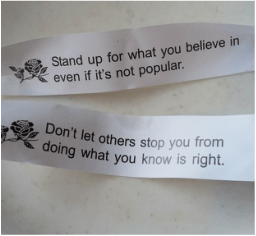
Live up to these two fortune cookie fortunes: “Stand up for what you believe in even if it’s not popular,” and “Don’t let others stop you from doing what you know is right.” I got these at dim sum lunch today. Umm, yes I ate two cookies… Resolutions two – find the gym, workout, and practice self-restraint.

Go to bed by 10.00 p.m. and wake up early to sit in silence. Probably won’t happen, since I’m writing at 10.50 and wide awake, but resolutions can be aspirational. If I go to bed by 10.00 I’ll wake up refreshed and ready to fight fakequity.

Build a new relationship with someone who scares me. There are a lot of people who I sort of ignore because they scare me. Some of their scare has to do with power, positions, or I’m intimidated, but a lot of that has to do with the stuff in my head, not reality. Building relationships is important to working towards equity. When we know each other well we can personalize and humanize our work which is important to pushing for change.

I resolve to ask better questions and read more work by authors of color. The art of asking questions is a hard one to master, but asking questions is critical to digging to the core of what is holding us back from achieving equity. Reading works by authors of color will give me different perspectives to understand and begin to ask better questions.

Predictions
The word ‘centering’ will become the new buzzword. Heidi and I had a long email discussion about centering, hopefully we’ll get around to writing that blog post. We’ll start to see Centering Committees in the next decade, then we’ll need to coin a new term “off-center-quity.”

We will see a rise in hyper-local efforts, and they will begin to get more attention. Already cities and municipal efforts are gaining attention for their ability to nimbly respond to changing demographics.

The tide is beginning to shift on dis-aggregated data. Data analyst and organizations are beginning to embed these practices into their everyday work. The next challenge is to look at how language and immigrant/refugee experiences can be pulled out from data. Lots to delve into around this idea, maybe we’ll explore it more in 2016.

Donald Trump will flame out and end up on Dancing With the Stars.

See you in 2016! Here’s to another year of fighting Fakequity.

Posted by Erin, picture by Erin Okuno

Are you have the conversation? Are you talking about race?

7413435At a recent training on equity I was paired with a program officer from a rural community foundation (rats, not a place we work otherwise I would have asked how to access funding). We chatted about our work, eventually our discussion veered towards what is happening in our organizations. I told her about   my organization, Southeast Seattle Education Coalition (SESEC), and how we hold equity and community as two of our core values and try to live those values.

As we talked, I shared how the turmoil from Trayvon Martin’s shooting, Freddie Gray’s death, and this past summer the violent death of a Somali youth who was walking home from a funeral of another youth made me question how I was leading for racial equity and living our values. These events forced me to evaluate where I stood, was I going to perpetuate fakequity—all talk and no action, or would I do something about it. My response was to open a conversation around race in education and to be intentional about how or coalition has open conversations about race.

My colleague said “wow…” in a tone that suggested she couldn’t have done that in her organization. For a moment I thought “I am in a privileged position to have these conversations,” then I thought no it isn’t a privilege, it is something we ALL have to do.

Recently another colleague told me about her experience. She works for an organization that says they want to embed equitable practices into their work. Their staff is largely White and my friend is African American. When the verdict in the Michael Brown shooting came out my friend talked to her boss and asked if the staff could have a conversation about what was happening nationally and how they would respond. During the meeting, her colleagues talked about how they didn’t think the email message about Michael Brown’s death was appropriate and they didn’t want to have a conversation about race. My friend left the meeting mad and frustrated. Fakequity is saying you want to do something about race, but only doing in a way that makes you comfortable.

“Can we talk about race now?”
Paola Maranan, Executive Director of the badass advocacy organization Children’s Alliance, recent spoke about policy and race and said “Can we talk about race now? Do we get to have the conversation? … We can’t build new systems or policies grounded in reality until we talk about race.” When we talk about race we are talking about the deep and personal stuff, in other word we begin to talk about values, our biases, and personal histories – the stuff that makes us who and what we are.

Depending where you sit and whom you talk to, talking about race is either constructive and important to solving problems or the third rail—talk about race and you get shocked. We need to talk about race and be honest; it doesn’t need to be a shock or a topic that makes people uncomfortable.

Last summer after the deaths of too many African Americans and East Africans, I decided it was time for our coalition to be more explicit in talking about race. I was in a position to respond, but the question was how and what would we do to contribute to the community. I was stuck, I didn’t know what to do or how to lead so I leaned on a few close friends and colleagues.

One of my trusted colleagues is in law enforcement. He sent an email checking in about other things and I emailed back saying I was stuck and restless, he generously offered to help think it through. We met for lunch and over sandwiches I explained my restlessness and frustration. I explained that I knew as an Asian American I was getting a pass on having to talk about race, and it wasn’t right. I felt the tension around wanting to respond, but in an appropriate way, to support the African American community and follow their lead. My colleague is a seasoned and wise African American officer who knows communities, government entrenched systems, and sees the good in a lot of people and places. He urged me to be the bridge builder and to use my position to bring communities together. I also talked to CiKeithia and Heidi, two trusted friends on the fakequity fighters team. CiKeithia told me about her frustration around not having a place to dialogue as a community about what the deaths of African Americans meant to her, in her words she said “I’m struggling.” With Heidi I laid out a few ideas, all of which were promptly dismissed because they were too surface level (she’s the Sherpa and I just follow her and buy her lunch in return).

What We Did – Can we be brave and talk about race?
Heidi came up with the idea of using historical documents to open a conversation around race and center the conversation in education (a realm familiar to all of our coalition members). The historical documents show that not a lot of progress has been made in the past century. She also designed the conversation around using race caucuses. This was an intentional design, by having people caucus the conversations were able to go deeper and faster, especially since we only had 75-min.

At our coalition meeting we had a packed room of partners. These are partners who showed up in the middle of a workday and devoted two hours to the meeting. It was a conversation I think many wanted to have and needed to have the space to talk and connect. When we talk about race we are talking about the deep and personal stuff necessary to build trusting relationships.

Heidi set up the session by giving people a framework of how to have the conversation. She talked about being Color Brave, put relationships first and be intentional about talking about race. The caucuses were meaningful and showed me where we need to do more work. We debriefed as a large group. The sharing was important because people spoke about their own experiences and what race meant to them. Having the conversation recommitted me, our organization, and our partners to speaking honestly and openly about what race means to us and our work.

What are you going to do? How are you going to have conversations about race?
We all have our roles to fulfill and we all can push for racial equity in different ways. Some will be on the ground marching and disrupting to bring important media attention to the cause, others will use their organizational positions to create policies that are designed to impact the racial disparities. What is your role? You have a role to play.

I’m not going to tell you what to do or tell you to read certain books, but rather ask some questions:
Are you having conversations about race within your organization. If you tell me your organization doesn’t deal with race that is BS, we are all impacted by it. Race impacts the environment, arts, education, sciences, entertainment, government planning, etc. Begin to dig deeper and you’ll figure out how and why race matters to your sector.

  • What conversations have you had about race? What did you learn?
  • Are you disaggregating data by race? If you aren’t you need to, people need to see themselves in the data.
  • Where are you getting your information? If everyone you hear from looks like you or you are comfortable with them, you’re not hearing from the right people.
  • What conversations are you avoiding because they are hard? Who do you need to talk to help push for more equitable policies and actions?
  • What is one thing you can do today to open a conversation about race? If you need some help pull out the fakequity chart and begin to think about a program or project you are working on and plot it on the chart then talk to your colleagues about what is working and not working

Some suggestions about how to start the conversation

  • Ask a few people and ask if they want to join you in a discussion. You can suggest something like lunch for equity, race to happy hour, be brave and drink your colors. Before gathering send out a short article or a TED Talk to launch the conversation.
  • Talk to your leadership team and explain why this matters to you and why you want to talk about race. Sometimes a conversation and a little nudge is all that is needed. Also be ready for some push back or to have this take longer than you might like, but some progress is better than none.
  • Be bold and bring it up yourself. We are all responsible for our own actions and we are all in positions every day where we can call out fakequity. Our individual actions make a difference.

I’m grateful people showed up at the Southeast Seattle Education Coalition’s conversations about race, it was the beginning of something deeper. We continue to talk about race, and our open conversations about race bring people to the coalition. While talking about race isn’t enough to fix problems, the open conversation allows us to build relationships and work towards equity from the inside then outward. Having conversations about race allows us and our partners to understand our beliefs, which we need to understand before we can build equitable policies and programs.

Posted by Erin, photo credit to Karen Fletcher