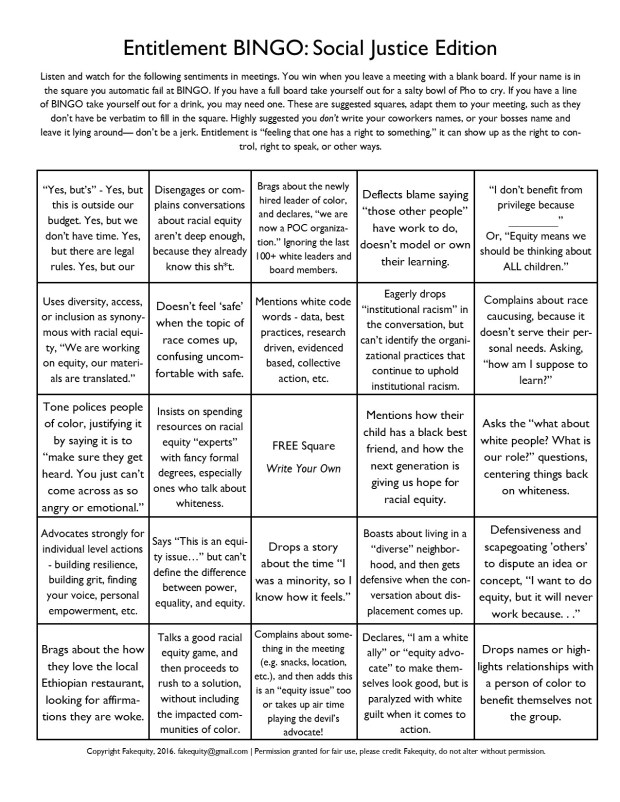
Entitlement BINGO – Social Justice Edition

entitlement bingo Social Justice Version .jpg

Social justice work is taxing, which means we need to have a little fun and call out fakequity in jest. Today we give you the next Entitlement BINGO card – Social Justice Edition.

In our collective work around social justice, racial equity, and community building work the Fakequity team has heard these excuses, lines, and witnessed these actions many times. This is our way of saying if you see yourself on the board, we aren’t calling you out. Many of us have committed these fakequity sins. In order to get closer to racial equity we need to grow and learn how to spot fakequity so we can stop fakequity and get to equity.

We offer this BINGO card in good spirit. We do not recommend leaving it lying around with people’s names on it. No one wants to see their name in a square on this BINGO card.

Some suggestions on how to use it:

  • Take the topics and start conversations about how privilege shows up in our social justice work
  • Use it to debrief a meeting asking attendees to talk about how power showed up
  • If you are leading a meeting share it at the beginning of the meeting to remind people of behaviors we want to squash

Share your suggestions for comments to put in the squares or how you think it might be used. If we gather enough material we’ll make another BINGO board.

PDF Download here: entitlement bingo Social Justice Version.
Entitlement BINGO — All About Me.

Posted by Heidi, with manini (little) help from Erin

No more “cultural competence” trainings and other thoughts about power

OLYMPUS DIGITAL CAMERA

It’s time to turn our backs on Cultural Competence Trainings.

Erin, our Chief Fakequity Writer, is away, so she left me with the fakequity keyboard. I’ve had a lot of random and not so random fakequity topics running through my head and scattered on post-it notes. Today, I decided to write a post calling myself out on fakequity in training. If we’re honest, we all have a little (or a lot) of fakequity we’re personally upholding. The good news is that I know I’m not alone in this struggle.

[Before I dive into this self-exposing blog post, I feel the deep desire to justify, qualify, or put my work in context. I need to affirm I’m a good social justice advocate. And this is one of the greatest barriers to doing real, raw, and truthful racial and social justice work. So like the old Saturday Night Live Stuart Smalley skit, I am just going to tell myself, “I’m good enough, smart enough, and doggone it, people like me.” And, I believe I’m not the only one who needs to expose the fakequity in my personal actions. This work is hard. And every time I feel the need to share my justifications, I’m going to do it in italics and brackets, so we can see how often this feeling shows up.]

I have been facilitating and conducting “cultural competence” workshops for the past ten years. Most of this work has been in mainstream, historical white and currently ‘mostly white’ spaces. Clients have been anxious to talk about differences, especially cultural differences. I have often been asked to talk about cultural competence in connection with community engagement, interpersonal communication, and access/inclusion. I have obliged. [Of course, from the very beginning I also talked about privilege and power, but mostly at the individual level and in more recent years more deeply at the systemic level.] But it has only been in the past year or so that I have told people I am no longer interested in conducting “cultural competence” workshops. Even my website still reflects this language. [But will be changed as soon as my copywriter, also known as the Chief Fakequity blogger gets back to Seattle.]

I believe “cultural competence” is popular because it allows mainstream systems, mostly full of white folks in power, to feel ok talking about cultural and identity differences, without talking about the uncomfortable topic of race and power. [I really wanted to believe that cultural competence could be an entry point into more explicit conversations about race and power.] But what really happens is cultural competence becomes a way to show or prove we’ve ‘checked the box,’ without changing or giving up power, and leads to people saying “I did it, I’m ok – I’m a good racial equity person.” I am not longer willing to be complicit in supporting the “good person/good organization” flag waving.

Let’s get real about power, especially racialized power.

I recognize we can’t talk about differences without talking explicitly about power. Race is the ultimate example of how systems and power have used (the perception of) differences to inequitable distribute power. We live and operate in a system where white people’s feelings, thinking, and doing are more valued. White people’s feelings are important, and I want people of color’s feelings, thinking, and doing to be equally valued. This means shifting power, which will feel like disequilibrium for many. But if you’re a true white ally or accomplice, you’ll understand that the way things have been centered around you, isn’t even good for you, and definitely hasn’t been good for people of color.

How most cultural competency trainings cater to white culture and upholds structural racism

Feelings: The unspoken and underlying appeal of these types of trainings are they are comfortable for white people, especially white people in power. Unintentionally, or not, most mainstream organizations practice tone policing – toning down anger, frustration, or direct truth-telling by people of color. Why should people of color need to make white people feel comfortable when we talk about racism? This hurts all of us by racializing power and holding back important stories about hurt, anger, injustice, and on the flip side hope, joy, and the coming together of communities.

Thinking: Mainstream organizations value people who speak English, can quote research and best practices, and have fancy degrees. If your organization values academia more than lived experiences by people of color experiencing racism and classism your organization is part of the problem. If you can only listen to people who sound like you and speak to you, you are part of the problem. Overvaluing the methods and ways white people think and frame ideas is racialized power. Ideas, brilliance, and experiences come in all different packages, some with fancy degrees attached and some without, some with an accent and some in a language other than English, some via PowerPoint and some via theater or spoken word.

Doing: I’ve started to refer to doing cultural competence training in groups of mostly white people as working in an echo chamber. Even if I present an idea or tool that has been created by and for people of color, it is still interpreted and filtered through mostly white experiences. Or sometimes, ideas I present are totally disregarded or written off as too idealistic, not realistic, or too radical. The ability to dismiss the ideas of people of color is racialized power.

 So are you ready to engage in racial equity work?

 Today I am more honest with clients about what I believe will advance racial equity for organizations. And, interestingly the power and freedom to be more honest about my work has also made me better at my work. Here are the four questions I now ask every prospective client.

  1. Is your organization ready to talk about race explicitly? This doesn’t mean I won’t talk about race at the intersections of other identities, but I will not work with you if you shy away from talking about race directly and deeply.
  1. Are white employees ready to be uncomfortable? The point to racial equity work is to disrupt the monopoly white people have on comfort. It’s ok, normal, and promotes growth to be uncomfortable some times. And, how people deal with discomfort is part of the learning.
  1. Are you willing to ensure, and offer compensation, so there are more than a token few people of color in the room? This is my commitment to no-more white echo chambers. This means organizations need to stipend community members, volunteers, students, or community partners to participate. It also means holding workshops at different locations or at different times to accommodate poc partners.
  1. Is your organization ready to slow down, change course, and try something new? Part of upholding institutional racism is we follow the same paths, approaches, and practices that we’ve inherited. Fast and “efficient” is not always productive. Yes, this also means your organization will need to dedicate more resources to achieving racial equity but the longer term outcomes are worth it.

The next time you think about hiring a consultant to come in and help you, ask yourself if your organization is willing to dig deeper. Ask some harder questions and try something new versus the standard trainings.

Post By Heidi
Spot the Fakequity Quiz

onionWhen Fakequity first started I periodically posted Spot the Fakequity questions on our Facebook page. I’d post an example and ask our Facebook community to write answers about where the fakequity showed up. Correct answers would win a virtual onion as a prize. We’ll explain why an onion at the end to keep you reading. I thought we’d play more Spot the Fakequity. Here is how it works, read the short statement and look for where fakequity (fake equity) shows up.

Spot the Fakequity: In an urban fire department at a Mayor mandated Race and Social Justice training, a white battalion chief says “We’re all good in this department. Look at the diversity we have here.” His department is majority People of Color (poc), leadership in this department is mostly white assistant chiefs, the Fire Chief (overall head who reports to the Mayor) is an African American, and the fire department’s mandate is they serve everyone in the city – anyone who calls 911 receives care, anyone who calls for prevention services receives services based on order received. The battalion chief boasts to his bosses how great the prevention services are in serving communities. Can you spot the fakequity?

Imagine being a firefighter of color sitting in that room wearing a blue uniform shirt and looking to your right to see your poc brothers and sisters in blue, then hearing the statement “I see diversity in the room” and looking to your left and seeing all of the ‘white shirts’ with badges who hold leadership. Not a great feeling realizing your boss doesn’t believe in your leadership potential, nor is he open to understanding his role in upholding institutional racism. Fakequity is in the battalion chief not recognizing the power imbalance in the room.

Fakequity also shows up in the prevention services they offer. By having a first-come first-serve model the department is practicing equality. Equity would be coming up with a way to prioritize low income communities of color would demonstrate racial equity.

Spot the Fakequity: The director of an education advocacy organization says “I have a focus on supporting all children; black, brown, and white children – they all need our help.” Can you spot the fakequity?

It is tempting to say “Oh they are practicing equity since they support children of color.” Nah, they are drooling fakequity. Racial equity work is about acknowledging children of color have different needs to be made whole, and to reach a fair starting point. The word all is dismissive of the experiences of people of color. All says we are all in the same group and we all have the same access to programs, information, leadership, etc. We need to recognize not all students need the same resources. Equitable practices is creating systems to target resources to students of color who need support. There is also a problem with the word ‘help.’ Communities of color do not always need help. We need access to resources, a recognition of opening and sharing power, and to be seen and understood.

I also smell fakequity in failing to acknowledge Asian, Pacific Islanders, and Native American students. Too often Asians, Pacific Islanders, and Native Americans (and probably a few other race groups) are left out conversations about racial inequities. Thanks for making us invisible.

Spot the Fakequity: A board member (policymaker) says “I just watched a great TED Talk on bias. I now see the importance of professional development for teachers on addressing bias in our programs. Teachers are the ones who are with our students everyday.”

I once heard the joke the TV show Law & Order is always on somewhere in the world. The desire to ‘fix’ things through trainings is like Law & Order – its everywhere. We like to send people to trainings to fix things. I’m guilty of this as well, earlier this week I co-presented at a family engagement conference on our coalition’s work with family engagement data. But it’s too easy to read a conference description and think “Wow this sounds amazing! I need to send staff to learn all about race. They’ll come back ready to go!” Just as you can’t solve a complex crime in one-hour (unless you’re Jerry Orbach on Law & Order), professional development alone won’t solve all of our classroom or program problems. Fakequity is for policymakers to think they can take the easy road to fixing problems.

Systems level solutions are also needed to achieve greater and more long lasting racial equity solutions. When we look at the systems in place holding students of color back we begin to really ask harder questions rather than the Band-Aid solutions of sending people to trainings. Creating more equitable systems doesn’t have to be overwhelming or hard, but it does take intentional work to look for why people of color aren’t thriving in the same system where white people thrive.

Fakequtiy vs. Equity
Did you spot the fakequity in the examples above? Fakequity shows up in wanting to do the easy stuff and not looking for the larger inequities, doing the harder work in engaging the community, and basically in being lazy in thinking and actions. Equity work is challenging and requires us to dig deeper and search for solutions. Racial equity work requires us to talk about race which makes many people uncomfortable. The rewards are there when we get our work right.

Legend of the Fakequity Onion
Around the time I started the Fakequity Facebook page, my colleagues James Hong, Heidi Schillinger, Jill Mangaliman, and I spoke to social work students at the University of Washington. A few days before my officemate Laurel Saito brought a gigantic box of onion from a farm near her parent’s house. As a joke and a way to share the onions I packed some for our presentation. When we got to the class James, Heidi, Jill, and I rewarded students who came up with the best answers with an onion. Onions were pitched all over the classroom. One student said “I’ve never wanted an onion so badly before in my life,” sadly he didn’t win one for saying that. This is how the fakequity onion came to be.

Who’s in Your Network?

Before we get to this week’s blog post please take a moment to fill out this three question survey on reading, books, and writing. Heidi, of the Fakequity Team, would appreciate your thoughts and she is offering prizes! If you’re in Seattle you can probably convince her to take you out for a bowl of pho or a taco as a prize, tell her she’ll grow her personal network (the topic of this week’s blog post).

Two GoFundMe Campaigns
social-network-links.jpgAs an avid procrastinator I often wander over to Facebook to read what is happening in my online network. Over the past few years I’ve noticed crowd sourcing for donations and support has become more commonplace and an easy way for people to ask and receive support from each other. A few weeks ago I saw a GoFundMe campaign in a group page. Sharon (not her real name) had a piece of business equipment stolen. The theft crippled her business and she didn’t have extra funds for a replacement. She humbly and reluctantly posted the online campaign page. Sharon is well-networked in her neighborhood, likeable, and her family while not rich is stable and comfortable. Within a few days she had made significant progress towards the campaign’s financial goal.
A few days later I saw a contrasting online campaign on a Facebook neighborhood page, Carla (fake name), is homeless and is asking for support to pay off outstanding fines in order to get a license so she could also get to work. She’s had less success in raising the funds needed even though her total is less than what has been raised by the other campaign. Some in the neighborhood supported her campaign, but there wasn’t as much community bonds or support on her posts.

Having watched both of these GoFundMe campaigns I was struck by the difference in how they were received and how people reacted to them. Sharon’s campaign was welcomed by her online social network, friends stepped in and made personal donations and left notes of encouragement. I’m assuming they wanted to help someone they know and like. We are inclined to support people who we perceive are like us and we can see ourselves creating a relationship with. Sharon is easy to like online and probably in person. Carla who equally needs support doesn’t have the same network of support even though she worked just as hard to retire her debt so she can also move ahead in life.

Network Equity or Fakequity
At a favorite program officer’s goodbye party another colleague mentioned she recently had an appointment with her financial advisor. Her financial advisor asked her if her charitable giving aligned with her values, her answer was “no, they don’t,” which prompted her to think about where she wanted her financial donations to go to. Having worked in nonprofits long enough I’ve learned a few fundraising lessons:

1.       We give because we’re asked by someone.
2.       We give to people, not organizations and to a lesser extent causes.
3.       We give to people we know.

If we believe giving is personal and we give to who we know and have relationships with than it also means wealth and charity stay within circles and networks. This also means the rich benefit themselves and communities of color which have historically overall had less wealth are at a disadvantaged. To get to equitable results we need to widen and deepen networks so we can gain and give more support to each other. When funding and support is concentrated it reinforces power and social dynamics that allow institutional and other forms of racism to continue. We need to slow down and ask ourselves are we sharing and opening our networks to understand diversity and to challenge the stories we tell ourselves about other networks and communities.

Our social and professional networks are essential a bunch of people whom we feel some affinity to or tolerate for a reason (such as an annoying co-worker, a funder we’ve inherited, a cousin-in-law, etc.). I like ninety-eight percent of the people in my network and am thankful they are in my network. But this also means if I don’t include anyone in my network who makes me uncomfortable or makes me question my thoughts, habits, or humanness I’m probably just hanging out with people like me. I really shouldn’t be hanging out exclusively with people just like me all the time, while I appreciate having a personal fan club, I also need to break out and understand the world more. As an introvert I find this notion incredibly taxing, but I know in the long run it is for the better. The more we all work to understand each other the more we can support each other and the more we share of ourselves and our many forms of wealth.

Three starter questions for examining your social and professional networks:
1.       Think about who is in your top ten people you like and describe or list how you know them. Did you grow up together or grow up in the same place? Did you go to school/college together? Did you work together at some point? If the answer is yes, they are probably similar to you in thinking and attitudes.

2.       Who gets your work time? Is it people you like and fine easy to work with? How many new meetings or new people do you seek out to meet?

3.       Who do you sit with at meetings people you know or do you try to sit next to someone new?

Posted by Erin Okuno


Fakequity or Equity in Community Engagement

2016-08-04 10.09.46This morning I got a treat. I spent the morning watching elementary age students participate in their Freedom School’s harambee. Translated from Swahili harambee means to ‘let’s pull together.’ The morning harambee included ridiculously energetic songs and dance, chants, and call and response. To create a greater sense of community they include recognitions that sound like this (read this in your loudest voice): “Hey, I got a recognition!” “A what?” “A recognition! I want to recognize you for being a fakequity fighter!” Let’s go fight more fakequity in community engagement.

A few months ago I wrote about community engagement and debunked a few myths. We’re returning to the topic to highlight some ways we can work together to build better relationships. Like the last post the words family and community will be used interchangeably.

Fakequity: Community engagement happens in individual relationships.
I work for a neighborhood based coalition, Southeast Seattle Education Coalition. We are intentional about bringing people into the coalition tent and encourage partners to build relationships not only with the organization and with each other. The more people know each other and form relationships the stronger our communities become. When we share our relationships we broaden and deepen the network of people supporting communities of color. With relationships comes access to information, new people, and resources.

As an example this morning on the Freedom School visit I brought a dozen people with me. The poor Freedom School staff didn’t realize I would invite so many others. nor did they know there would be over a dozen emails exchanged to arrange the tour. The people who came on the tour are amazing coalition supporters, and now they aware of another program and experienced the magic of community building. Community building isn’t a zero-sum game where if I have a relationship and I share it the relationship transfers; in reality the relationship network is now multiplied. This morning I saw many who hadn’t known each other before the visit chatting, building new relationships, and exchanging business cards for follow up. It will take a while for these relationships to yield tangible results, but the network of support is wider and deeper to allow sharing to happen.

Fakequity: Look outside for answers.
On the tour of the Freedom School Martin, the site coordinator, talked about how he encourages his Servant Leader Interns (what they call teachers) to look within their classrooms to solve problems. This includes smaller problems like resolving conflicts between scholars and larger social problems such as inequities in their schools and communities, many times the servant leaders found their scholars had suggestions about how to fix complex problems such as housing, hunger, etc. These children are living with the problems and they understand their community better than an outsider.

Communities, including schools, often know the solutions to their problems. What communities and families need is access to resources (e.g. information, money/capital, relationships with people who can clear barriers, etc.). A few weeks ago I sat in on a Head Start Policy Council meeting. Parents of color, many of whom who are immigrants and refugees, are taking the time to share what is working and not working at their Head Start program. Some of the problems were complex and there were also a few problems that were more easily resolved with increased communication or quick fixes. They didn’t need to bring in outsiders, new curriculum, consultants, or others to fix problems. The solutions were within, but more importantly the program has a system to listen to parents who traditionally don’t have access to decision makers so they can be heard and remove barriers to problems.

Community Engagement is About Others
Heidi (of the fakequity team) reminds me community engagement is about sharing control/power and recognizing often times that is uncomfortable. The discomfort shows up in big and little ways – leaving the building to go where families live or work, providing interpreters and translated materials, changing language to be accessible and understood and avoiding jargon, and bigger ways including changing practices and habits to be more inclusive and sharing of decision making power.

Community engagement is about sharing control of agendas, decisions, and having ongoing discussions about race. Can we make ourselves a little more uncomfortable and share access, relationships, and agendas? The temporary discomfort of having to work differently will be rewarded with better community engagement. If you need a little positive community engagement gather a group together and create your own harambee — remember community engagement is pulling together with the community, watch this video of a Freedom School’s harambee, it will get you out of a funk and into the community.

Posted by Erin Okuno

Who Are You? How do you identify yourself?

candy heartI’m on a train northbound from Portland, OR. I love visiting Portland: tax-free shopping, food carts, consignment shops, and wandering around Powell’s City of Books. Being in a new city often crystalizes or magnifies things differently for me. One part of racial equity work I thought more deeply about while in Portland is how we identify ourselves and who gets to control that narrative.

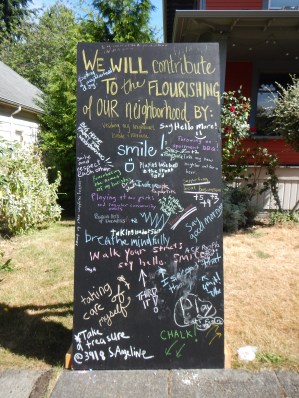
Self-Identities

While in Portland I sat in on a panel on the Coalition of Communities of Color (CCC). I enjoyed hearing from some of the founding members and what they thought and remembered about the forming of the coalition. One of the concepts that stuck out was hearing an elder talk about the importance of self-identification and self-determination.

As an example recently in a meeting we started the day by inviting participants to share our self-identities. The group had been together before, but we hadn’t taken the time to share our backgrounds beyond the typical name, organization, and role. Since this group is focused on communities of color we took some time and talk about how we self-identify and the stories behind our identities. A colleague from the Somali community shared her name, including her eleven names which allows her to trace back her clan lineage eleven generations. Another colleague said “Pinay. That one word is how I identify. It captures my Filipina identity.” My Pinay friend talked about her background of coming over as a child immigrant and being a member of the 1.5 generation (children who immigrate and grow up in America), this was so much more interesting beyond just hearing where she works and what she does.

Taking time to share our identities helped us come together more quickly. We took time to listen to each other and stopped assuming or guessing each other’s backgrounds. When I introduced the activity I admitted I had made assumptions about others in the group, some of them right and many of them probably inaccurate. Intentionally slowing down to have a dedicated conversation about our identities gave us new vocabulary and insights into each other.

Centering People of Color through Self-Identity

The activity re-centered people of color and decentered whiteness. Often times we make assumptions about each other, including about white people. Through this activity we invited each other, including our white allies to name and identify how they see themselves. By inviting everyone to self-identify we leveled the playing field including allowing our white peers to say “I identify as white, my background is [this].” Some of the allies named their role in the group as an ally. By having to name their alleyship it re-centered people of color. Many times as people of color we are asked to check the box or we fill a spoken or unspoken quota that whites don’t always have to participate in. Taking time to identify ourselves can highlight how white-dominated meetings can get, which is important to acknowledge and creates more space to elevate voices of color.

Invitation to Share

If you want to invite people to share their identities, please be aware of the following:

  • Invite people to share, but do not force or pressure them. As people of color we’re sometimes (way too often) asked “So where are you from?” “From Seattle.” “No really, where are you like from?” People shouldn’t feel pressured to share beyond what they are comfortable sharing.
  • Remind the group what they hear from others is their narrative and others shouldn’t volunteer or share another person’s narrative. Recently a colleague shared a story about how during a share-out an attendee began shared someone else’s personal answer; the sharer was exercising a form of power by taking someone’s narrative without asking permission. Tell people to share their own stories, not others unless they ask permission.
  • Model an example of how to share a narrative. Keep it fairly short (unless you have a lot of time) and ask people to talk about race. As an example this is how I self-identify: “Hi, I’m Erin. I identify as Asian American, specifically fourth generation Japanese American, by way of Hawaii. The part about being from Hawaii is important to me for many reasons; we can explore more during happy hour. I use the pronouns: she and her.”
  • Encourage everyone in the group to self-identify, including white participants.
  • If you have a large group, consider using a timer. 1 or 2-min to speak is often enough time.

Posted by Erin Okuno

Will You Choose Mindfulness and Reflection or Choose to Chew Someone Out

IMGP0391

One-Minute Reflection

Earlier this week several partners and my organization co-hosted a candidate forum for Washington’s highest education position. We had a great event with over sixty community members, many of whom were people of color.

My colleagues Sharonne Navas, Executive Director and Co-Founder of Equity in Education Coalition, and Joyce Yee, Community Organizer at League of Education Voters, came up with a community designed and centered way to host the event. The candidates met with attendees in table groups of about ten people each, spent fifteen minutes conversing, and then rotated to the next table group. At these table conversations attendees could ask questions and have a dialogue. No one screened questions or reinterpreted questions; a barrier, in this case a stage barrier, was removed between candidates and the audience. It was great to hear table conversations happening and also telling when the table sessions went silent.

At the end of the event we invited the candidates back to the stage for closing remarks. Instead of inviting the candidates to give their stump speech closing I asked each candidate to share what they heard from the attendees. In equity work it is important to reflect and to think about what we heard and how we interpret it. By asking the candidates to do a one-minute reflection we were inviting them to internalize what they heard from the community. This reinforced the event’s focus on our community and centering the event in communities of color. The candidates’ comments were telling about who listened and heard from the audience versus who wanted us to hear about their platform.

Mindfulness, Reflections, and Moving Forward Together

Good, thoughtful, and ongoing racial equity work requires time to reflect and to check in on our assumptions, beliefs, and values. Today while facilitating a coalition meeting at the last minute I switched things up and I’m glad we did. Normally after the main presentation we transition to announcements, but today we paused- literally paused for ten-seconds, and created space to share appreciations. I’m glad our coalition took valuable time to do this. The appreciations spoke so much to the type of community we want to create – one where we value people and relationships, and one where we can also focus on the good. A partner reflected ‘I appreciate taking the time to say appreciations.’ After I heard this I said this was a new practice, and I felt it was important to focus on good experiences, not just the negative news about race and inequities. I’m grateful this appreciation was shared because it makes me want to embed this more into facilitation skillset and it helped me learn and grow from a positive experience.

The appreciation exercise brought me back to mindfulness practices and embedding it in our everyday interactions. Often when I’m facilitating or executive directing (a.k.a. being an executive director of an organization) I’m responding to others. Many times when we are on the spot we have to react quickly and think quickly, however racial equity work is about purposefully slowing down and capturing the disconnects that allow racism to continue – being mindful in my responses allows me to slow down for a moment and reprocess and ask, how do I change my response to a situation.

My former boss studied mindfulness and he was a better boss because of it. Once we were driving to a meeting and already late, I gave my boss wrong directions and we missed an exit. He didn’t get upset he said “In being mindful, I can’t control or change the past. The only thing I can do is control my response to what is happening right now. We missed that exit one minute ago, it is now the past.” This mindfulness message resonated with me, he had every right to get frustrated with me, but he didn’t—we moved forward, together. When we think about racial equity work we will inevitably slip up and say or do something offensive or be on the receiving end of an inappropriate comment or action. We also have the choice to linger on it or be kind and brave in how we respond and continue to build a relationship.

In reading more about mindfulness I’m reflecting on how we arrive at the work and our conversations around race. We can choose to arrive at conversations around race with an openness to learning and generosity, or we can choose an attitude of race-baiting (using coerce language to provoke a response), predatory-listening (waiting for someone to slip up and throw what they said back at them), and looking for fakequity. I hope we choose kindness, which takes intentional work of both whites and people of color. As a poc I need to make sure I’m looking for learning and being open to hearing multiple versions of a story openly and with an intent to understand. Being open and willing to learn allows for so much more learning and generosity.

For me reflecting and mindfulness show up as:

  • Reflecting back on what I heard about race or culture and linking it to a different experience.
  • Being mindful with my words also requires listening first before speaking.
  • Reflecting means intentionally slowing down and changing a practice or behavior.
  • Mindful about the biases I hold and how I project them, am I cutting off a person from speaking because of a bias, am I avoiding a meeting because of something unreasonable, do I complain about certain things because of a bias?
  • Finally, how do I show appreciation, especially to people I have a harder time naturally connecting to.

Posted by Erin Okuno

Allies: Where were you Last Week? Where will you be Next Week?

Where Were You Last Week?

Last week I saw a lot of social media messages of sadness, anger, and heartbreak in response to the latest deaths of African Americans by white police officers. I felt it too, and I asked myself what am I doing around racial equity in my community. I spend a lot of time thinking about race, closing achievement gaps, community, compassion and empathy, and my privileges. Even with all of my thinking and processing about empathy and community, I was annoyed. I was annoyed with the sudden chorus of people posting to social media about how upset they were. I know I shouldn’t be annoyed, but I was because racial equity work is something we need to work on every day not just when there is a tragedy or when everyone else is talking about it. I wanted to ask people who posted “Where were you last week? Where were you last week when the little things were building up to tragedies we see in the news today? It didn’t just happen, we needed you before the tragedy and we’ll need you tomorrow too.”

The problem with only posting or talking about race during a crisis or when everyone else is talking about it is we fail to remember the real work happens in everyday conversations between friends and colleagues and daily choices. I hope allies will continue to use their voices and move to action. Recently I was at a dinner called Unity in Community, it was designed to open up a conversation about race. A white colleague talked about how he had been in a heated discussion on race with colleagues who ‘didn’t get it.’ He said he engaged in the conversation as a white ally. He also said “it was exhausting and I recognize I can step out of the conversation as a white person. People of color can’t always step out.”

We need allies in the conversations, not just when there is a chorus and not just to do the easy actions of posting to social media, donating to the same slate of nonprofits who claim to work with communities of color, and hangout in ways that are ‘safe’ and comfortable. We need to do the harder work, the everyday work, of learning about how race impacts people, forming new relationships with people who are different than us, and de-centering practices that benefit communities who are already thriving.

What Are You Doing Next Week? We Need Actions and Relationships.

Our actions speak volumes about what we believe and value. I’m hoping people will engage in dialogue and push for change. Racial equity wins are made between news cycles, change happens in boardrooms and classrooms, the wins come in conversations and when we change practices to benefit communities and people of color.

Earlier this week on a local parenting Facebook group I started a thread inviting people to DSCN2966introduce themselves. The online group has been together for a while, but often times posts are transactional or asking for advice on parenting situations. I wanted to pause and find out who is in the group, relationships can’t form if we don’t know who is there. Allies become allies when we know who is around us and we understand each others backgrounds.

The thread is great, people discovered commonalities and it is neat to read who is in the online community. The roll call of members also highlighted blind spots for the group, such as who is underrepresented and how easy we default to dominant ways which become a club of the like-minded. I was heartened to read people’s posts, including where group members engaged in conversation around race, sexual identity, and privilege. These online conversations were more productive because people were willing to share and dialogue. Now the question is how do we continue to use the space to push for equitable changes in our broader community; I know it will be easier because we have a better idea of who is in our community, both people of color and allies.

I hope everyone, especially white allies, who were outraged, sad, angry, or confused during the turmoil of the last week choose to use some of that energy to do something differently. To get to racial equity we must change and evolve. Perhaps as a first step is to pause and get to know the people in your community, especially people who are often outside of our daily encounters. The new relationship may help to bring about new thinking that helps to alleviate some of the anxiety and sadness, and propel us to action.

Posted by Erin Okuno

Accommodations versus Doing What is Right — Fix the System

candlelight

photo by Erin Okuno

One of the drawbacks of pre-writing blog post (which almost never happens) is racial equity work is always evolving and changing. I am thinking about Philando Castile, the 123 black person was killed by a police officer this year and Alton Sterling. We remember the shooting in Orlando killing of LGQBTIA Latinx community members and the need for people of color to call for gun control. Tonight police officers were killed in Dallas – I have friends and colleagues of color and white who work in emergency services and law enforcement, I am thinking of you. This week many celebrated the end of Ramadan, a time for community. CiKeithia said it best: “We need to know each other more than ever,” that is at the heart of equity work – knowing each other and building the relationships needed to see equitable changes. I’m asking myself what is my role, what actions do I need to take to prevent another death. A few weeks ago Heidi wrote about how we must show our love for our communities and move to action. I hope you will join me in changing one thing today that will drive towards more racial equity, take a real action not just a social media post — get to know someone new, challenge a policy you believe upholds racism, do something. 

Over the Fourth of July weekend I was flattened with a cold. Between shivering with the chills and napping I laid around and watched Netflix. Since it was the Fourth of July I watched the second most patriotic show after the West Wing, season two of Madame Secretary; a show devoid of Asians, Native Americans, Latinx, and Muslims except in bit parts, I’ll save that rant for another day. During a scene where the Secretary of State is arguing to keep America out of war (basically every other episode) I started thinking about how we work to ensure we bring out the best in each other versus react.

At one point, Secretary McCord breaks down and says “I’m good at responding to crisis situations, I suck at the other stuff.” For good and bad systems, policies, and laws are good at reacting in crisis situations (i.e. nuclear attacks, financial meltdowns, hurricanes, etc.), but overall slow to change. The good is our systems preserves and keeps organizations, government, and society stable; we aren’t subject to the whims of a wacky leader or dealing with constant mayhem. The bad means we are slow to make changes and to make corrections or to understand the needs of our changing communities.

We need to recognize that what may look like a common everyday situation to some is actually a crisis situation for communities of color. Such as how is it not a crisis to have children of color not in school, it is a crisis we can’t get clean water to communities of color, and it is a crisis over ninety percent of teachers in Washington state are white but fifty-four percent of students in Seattle Public Schools are students of color. At the same time, we also need to stop responding to crisis situations with band-aid fixes/accommodations and start fixing systems that hold people of color back. Responding to a crisis or an urgent situation we create an accommodation, a one-off or a special circumstance. We need to move beyond these special circumstances and begin to shift practices to benefit people of color and embed it into our systems.

As an example I’ve participated in a philanthropic group, Social Venture Partners (SVP) Seattle, as a Brainerd Fellow. The Fellowship was created as a way to diversify their membership and to allow nonprofit professionals who can’t afford the participation fee of $3,000 into their organization. Without the accommodation, a fee waiver, I wouldn’t have participated which would have been unfortunate since I got a lot out of it. I know I brought equal value to SVP by sharing what I know about nonprofits, community engagement, and racial equity to SVP. Many have talked about how important it is for the field of philanthropy to diversify — philanthropy controls discretionary giving to nonprofits and having people of color involved changes the conversation and hopefully creates pathways for money to end up closer to communities of color.

We often provide accommodations in bits and pieces, such as when we offer interpreters and translated materials, child care, transportation stipends, and other services that help people participate. We need to move beyond accommodating and move to fix the practices that continue to  keep people of color from participating as our best selves.

Accommodations aren’t Enough – Systems Define the Results
Accommodations are great, but they aren’t enough. We need to stop accommodating people of color (poc) and start centering our work around poc needs. Centering our work around people of color will highlight the barriers needing to be removed in order for poc to participate. When we think about what people of color need to be ‘whole’ and to participate the conversation changes and our systems, practices, and beliefs will change as well.

Leaving things at accommodations ‘others’ those receiving accommodations. While I value my participation with SVP Seattle’s fellowship it took a while to feel like I was a part of the partnership and not a token participant. The financial accommodation was important, but it was just that an accommodation not an integrated part of the organization. We need to move beyond accommodating people of color and asking what are we doing to build inclusion and re-centering our work around poc needs and strengths.

Imagine what our public participation processes could look like if we stopped accommodating and started integrating smarter community processes into our work. Such as every time I go to a school board meeting and see parents trying to entertain their children’s needs I think “Wouldn’t it be great if we say because this is a school board meeting and we value children, why isn’t there onsite child care during the meeting so parents/caregivers can participate?” Centering the meeting on the needs of children, especially children of color, would lead us to ask different questions and ensure better participation of families of color.

Some things to think about:
What are the barriers to people participating — Are there cost barriers, if so how can we eliminate those barriers? Are there time or technology barriers? Can we go to people and get to know them so we can encourage their participation?

What are you doing for one person to allow them to participate– Chances are you might be providing a special accommodation for someone in your program to participate. Can you take what you’re doing for that one person and take it to scale?

Who are you listening to– We often are willing to create accommodations for people we hear from, we need to make sure we are hearing from many people of color in order to make sure we are creating change with pocs in the center.

Let’s stop responding to crisis and start intentionally asking smarter questions about how we can infuse more equity into our systems.

Pride Flashback: Do you remember 1996? Were you There or were You on the Sidelines?

p6260120

Pride Parade Seattle, photo by Heidi S.

Last Sunday, I managed to navigate the crowds and spend a few hours at the Seattle Pride parade. The crowd was massive, in fact a little overwhelming. And the parade didn’t disappoint. It was festive, beautiful, fun, and full of community groups, nonprofits, government departments and elected officials, businesses, religious groups, etc. It felt like everyone was there. In fact, it is really starting to feel like the Pride parade is the place everyone and every organization wants to be seen.

What I couldn’t help but wonder is if all the straight ally community groups, businesses, politicians, and religious groups were there 20+ years ago. Did your organization support gay rights before the American Psychiatric Association removed homosexuality from the list of mental illnesses, before sexual orientation become part of the protected class from discrimination, before “Don’t ask, Don’t Tell” got repealed, before legal same-sex civil unions or gay marriage, before the Supreme Court ruled in favor of gay marriage nationwide? Did your organization stand up for LGBTQIA (Lesbian, Gay, Bisexual, Transgender, Queer, Intersex, Asexual) rights when it was uncomfortable, when you really risked losing funding, getting targeted or boycotted, when no other organizations around you were standing up?

Don’t get me wrong the current support feels great! It feels like the warm societal hug that I wanted and needed when I struggled with coming out. It feels like the affirmation I needed when I wished my life could just be more “normal” (read: straight). It feels like the support I wish I had when I couldn’t and wouldn’t talk about my “partner” and ended up referring to her as my “roommate or best friend.” It feels like the support I really wished I had 20 years ago.

Remembering 1996
Let’s go back 20 years. It’s a nice round number, and also happens to be when I graduated from college so I have clearer memories of that time. For those of you whose memories are worse than mine, or those of you who were too young to remember 1996, here are some mainstream pop culture highlights. The Macarena was the number one music single (you’re doing the dance I hope). The number one grossing movie was Independence Day. It was also the year Jerry Maguire came out, “Show me the money.” Nintendo released its first gaming console. A postage stamp cost 32 cents. And, Prince Charles and Diana, Princesses of Whales got divorced. I still had bangs, wore my clothes way too baggy, and was contemplating putting a corporate logo on my body. I am happy to report I was wise enough then to not get the tattoo.

The LGBT context in 1996 was not as festive as the atmosphere at the Pride parade on Sunday. The United States Court of Appeals for the Second Circuit upheld “Don’t Ask, Don’t Tell.” The United States Senate passed the Defense of Marriage Act (defining marriage as the union between one man and one woman) in an 85 to 14 vote, and rejected prohibiting discrimination based on sexual orientation in the private sector in a 49 to 50 vote. And, based on a Gallup poll, 68% of the public opposed same-sex marriage. Contract that with the now 61% of people who believe in same-sex marriage in 2016. I think it’s fair to say that if you or your organization were standing with gay people in 1996, you were taking a risk. You were brave at a moment in time when it was uncomfortable to be brave. You were an ally or accomplice when it wasn’t trendy or easy to stand beside us. We also hope your organization was changing policies and behaviors to model inclusiveness and acceptance.

A Fakequity blog post wouldn’t be complete without a racial equity analysis. So here is a little taste of what societal racism looked like and sounded like in 1996. The O.J. Simpson trial had just ended in an acquittal a few months earlier in October 1995. Hilary Clinton’s infamous speech where she talked about “certain kids as super-predators” happened in 1996. She made the comment in reference to Black urban kids to justify “three strikes.” A referendum to end affirmative action passed in California. Over 30 Black Churches were burned down in nine different states. It was also the year of the “Hollywood Blackout” at the Academy Awards. People magazine featured a story announcing of the 166 Oscar nominees, only one was black. Yes, this happened in 1996 too (and most years before and after), even before Twitter and 2016 trending #OscarsSoWhite.

As for looking at the intersection of sexual orientation and racism in 1996, I couldn’t find much reference to gay people of color, except for a few academic articles. It’s as if we didn’t exist. Which is strange because now I know plenty of gay people of color who were around in 1996. The invisibility of our experiences in how and what we remember about homophobia and racism speaks loudly.

The 1996 LGBTQIA Context Still Exists in 2016
I am aware that Seattle’s Pride parade is a bubble, although an expanding bubble. I know that we still have work to do gaining acceptance and full rights in our society. This is particularly true in places, communities, and organizations that still feel like that 1996 context. In fact, that 1996 context is everywhere. Here are a few places that come to mind:

  • In white dominated LGBTIA space – Too many LGBTQIA spaces are full of whiteness. Too many spaces are disproportionately (and often, unintentionally) focused on addressing LGBTQIA issues in white communities and for white people. The voices, perspectives, and experiences of LGBTQIA people of color are missing, silenced, or ignored. We need White individual and organizational allies to no longer tolerate these spaces. We need you to direct resources to the amazing things that are happening in Queer POC spaces.
  • In many communities of color – As a queer person of color, I know talking about relationships (besides persistent questions about marriage to someone of the opposite sex), much less sexual orientation can be taboo in many communities. There are also cultural issues upholding silence around homosexuality. This is often complicated by societal pressures to assimilate to white norms and give up aspects of our culture. But we need to explicitly address the messages that are putting our cultural identities at odds with being gay. We need to be talking about the mass shootings in Orlando at a gay club, and the disproportionate impact the Latinx and Muslim communities with our families. We can’t avoid addressing the fact that in the words of Alan Palaez Lopex, “It’s not safe to be a queer person of color in America.” This is especially true for transgender people of color.
  • In the anti-transgender movement – This is happening everywhere. From the recent attackon a transgender man on Capitol Hill in Seattle, to the waste of resources and energy on anti-transgender initiatives such as Washington’s I-1515. As a community and country we should really be directing our resources and energy to fighting the fact that according to a 2013 national report “More than two thirds of the homicide victims were transgender women, while 67% of victims of homicide were transgender women of color… This data follows a multi-year trend where the victims of fatal hate violence are overwhelmingly transgender women, and in particular transgender women of color”

What are you going to do today? Do you want to be a leader or a follower?
Ten and twenty years from now what do you want to say you were doing to advance social justice causes. Do you want to say you were marching and working with communities of color or do you want to say you were on the sidelines?

Recently Erin told me a story about how Starbucks failed #RaceTogether campaign makes other Fortune 500 companies leery about boldly leading on racial equity. Starbucks took a risk and it didn’t work, but doesn’t mean they and others shouldn’t continue to push for social justice causes and examine and speak out about racism. Do they want to be on the sidelines or do they want to be leaders? The same conversation people were having in 1996 about being seen in the Pride Parade.

Posted by Heidi Schillinger